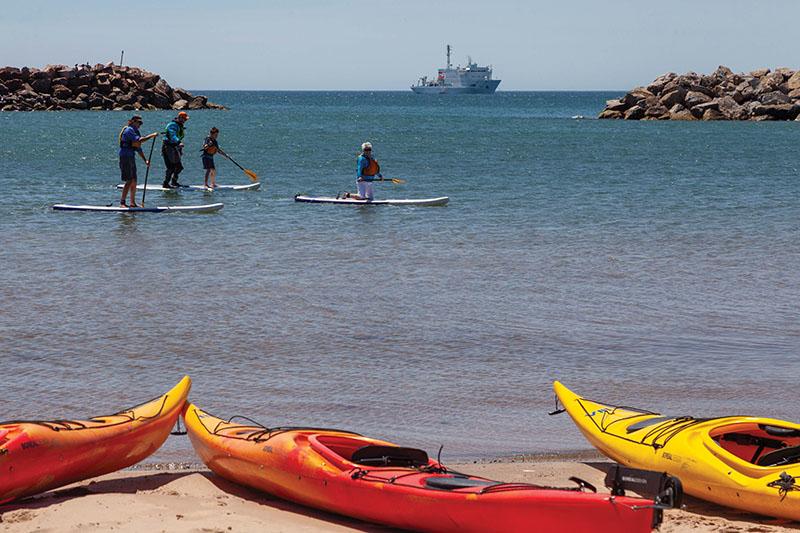
I’m onboard the Akademik Ioffe, a Russian icebreaker that has dropped anchor more than 100 miles off Canada’s Nova Scotia. And, like everyone else on this One Ocean Expeditions cruise, I’m peering at the fog that shrouds this notorious area of the North Atlantic for 125 days a year.
Suddenly, a low stretch of coastline looms out of the murk several hundred metres away – Sable Island. A mysterious, crescent-shaped sliver of sand on the edge of the Grand Banks, mariners have long feared its name.
Sable Island is known as the Graveyard of the Atlantic, claiming more than 350 ships over the centuries. Three major ocean currents meet there, creating treacherous, storm-tossed seas and thick fog.
A national park since 2013, Sable measures just 25 miles by one mile and is home to 200,000 grey seals, 550 wild horses descended from Acadian horses brought by ships, and a handful of Parks Canada staff and scientists. Typically, only 50 to 200 people a year visit the island, as it is so remote and conditions are often too dangerous to land.
We are lucky. Today, there is a gentle swell and we board the ship’s Zodiac inflatables via the exterior gangway for the short transfer once our clothes, shoes and bags have undergone strict biosecurity cleaning. Inquisitive seals pop their heads above the water to check us out before the helmsman picks a wave to surf the craft onto the beach, where One Ocean staff help us clamber out and wade ashore.
Leaving our lifejackets, wellies and waterproof jackets and trousers in piles on the beach, we split into groups to explore the island. I join official photographer Jeff Topham and ornithologist Chris Di Corrado.
A lazing seal eyes us warily as we trudge by on pristine sands flecked by occasional
flotsam and jetsam. Park staff monitor the debris; we mustn’t touch it.
We spy one of Sable’s fabled horses on a nearby sand ridge, munching on the tall grasses covering much of the island. Taking a path over the ridge reveals a vista of grassland edged by huge sand dunes that fade into the still-present fog. We walk towards one of Sable’s freshwater lakes, near where more horses have gathered, keeping the required 20-metre distance from the lone horse when it trots past us to join the others, its long, shaggy mane flying out behind it.
On our two-hour nature ramble we come across exquisite flowers, tiny mushrooms and one of the rare Ipswich Sparrows that only breed on Sable Island. We hike through a desolate dunescape reminiscent of Star Wars planet Tatooine, clambering to the top of Sable’s highest dune to enjoy a panoramic view of the narrow island and surrounding ocean, before heading back to the beach to don our waterproofs for the return Zodiac ride.