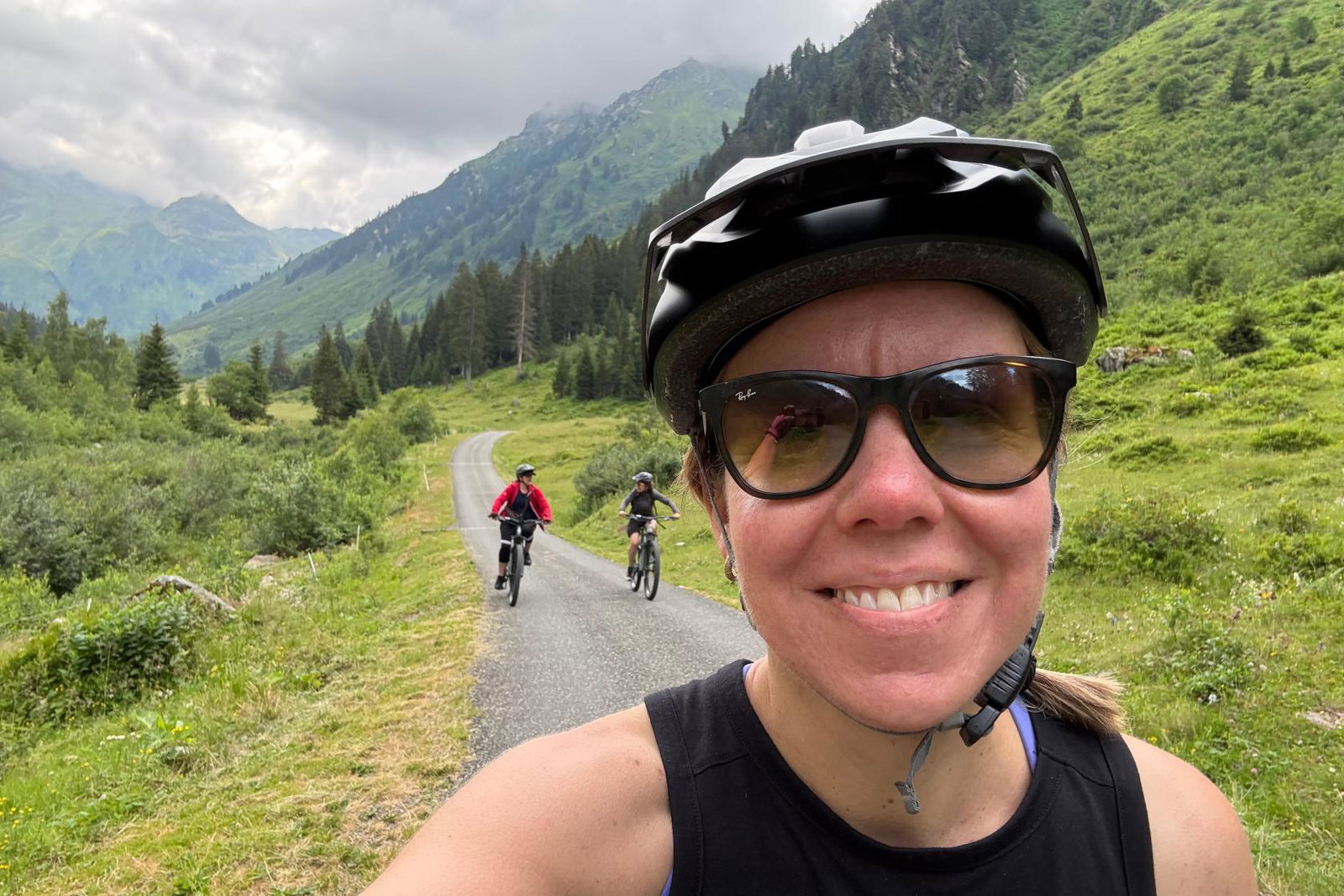
I wonder if this is what it feels like to fly? As I coast downhill on my bike, along a stretch of road that’s as smooth as it is straight, I’m as free as a bird. There’s a vast panorama every way I turn; the long valley, carpeted in wildflower meadows and dotted with immaculate chalets and farming huts, is encased by steep evergreen mountains. My gaze is drawn ever higher to their craggy peaks with the odd lingering patch of snow.
Nature supplies my soundtrack, first the rushing of white water from a river that runs the valley, later the melodious clanging of cowbells. Only one of the hardy-looking herd they adorn lifts its head up from grazing when I fail to suppress my whoops of joy.
I have been using an e-bike hired from Andrist Sport to ride from Klosters to Alp Sardasca and back again, a total distance of 24km. Our turnaround point is an honesty bar or ‘syrup bar’ where local beers are cooling in the freshwater fountain.
The first half of the ride has the uphill sections, but I manage them easily by boosting my bike's power to its maximum. What a wonderful invention e-bikes are.
Since exiting Klosters I’ve seen more hikers and cyclists than cars. With this half-day ride just one of myriad trails extending away from the mountain village, it’s plain to see why Klosters needs to be known for more than being King Charles III’s favourite ski resort. I had already taken a cable car up Madrisa, the local mountain, which offers a host of family-friendly adventures, from children’s snow parks to overnight treehouse stays in summer.
Still, Klosters and the royals are intrinsically linked, and a guided walk acquaints me with the town’s famous connections – for four decades, Charles was a regular visitor to Klosters, and often stayed at Hotel Walserhof, while sons William and Harry danced on tables in Casa Antica, a nightclub that has stood the test of time.
Where stars come to play
Easily walkable and with a year-round population of just under 4,500, Klosters has an intimate, boutique vibe. Locals close ranks around visiting royals, Aurelia Schmid, from the Davos Klosters Tourist Board tells me, and that’s why Charles liked it, although William and Catherine favour trendy Courchevel these days.
Perhaps the reason Klosters folk were not star-struck when they bumped into Charles when he was Prince of Wales was because Hollywood stars have been coming to the resort since the 1950s. Hotel Chesa Grischuna’s guest book provides a veritable Who’s Who of Hollywood’s Golden Age, with Gene Kelly, Greta Garbo, Audrey Hepburn and Paul Newman just a sample of those who feature. Their presence earned Klosters a 'Hollywood on the Rocks' nickname.
On the subject of famous guests, Klosters’ near neighbour Davos also has its fair share. Every January, Europe’s highest city hosts The World Economic Forum, when more than 60 heads of state and government join chief executives of multinational companies to discuss global challenges.
Good luck getting a hotel room when all these leaders and their entourages are in town, cautions Aurelia, before adding that as a resident, it’s actually one of her favourite times of the year, when “the world comes to Davos”.
'The mountain cure'
With a permanent population of 10,500, Davos is more urban than Klosters. Although still ringed by mountains, it’s not as traditional. That doesn’t mean it lacks a storied past though – Davos first came to international attention as a health destination in the 1860s. After a couple of German physicians promoted the “curative” benefits of clean mountain air, Davos quickly became fashionable.
If your clients want to step back in time, direct them to Berghotel Schatzalp, a former sanatorium turned historic hotel, sitting pretty 300 metres above Davos. The Art Nouveau property is still reached by funicular, and retains many period features from when it was built between 1898 and 1900. These include original fittings in bathrooms, plate-warming food elevators connecting the kitchen with guest floors so fresh, hot food could be served to bedridden tuberculosis patients and step-up balconies, designed to allow an extra two hours’ sun exposure. A former doctor’s workspace has a treasure trove of antique medical implements.
My visit to Schatzalp is marred by rain-sodden skies, which doesn’t help shift a feeling I have that I’ve landed in Stephen King’s The Shining as I tour the cinematic hotel. The lack of televisions in guest rooms is to deliberately encourage digital detox and immersion in nature. For these reasons, staying the night here won’t be every client’s cup of tea.
But you should absolutely encourage clients to head up for a visit, and to indulge in the regional specialities served in the Panorama restaurant. Based on tantalising glimpses through peekaboo-playing clouds, I assure you the views merit it. And trying hearty Capuns (doughy leaf-wrapped parcels covered in a velvety cheese sauce) makes it all the more worthwhile.
World-famous scenic trains
There are other reasons to visit Davos – to cheer on the most successful ice hockey club in Switzerland and to enjoy its cultural events. But like Klosters, many use Davos as a base to explore its easily accessible alpine surrounds. It’s from Davos Platz station that I board a historic train from the Rhaetian Railway, viewing the spectacular mountain scenery from its open-air carriage like a continuously evolving landscape painting.
At Filisur, I swap into the Landwasser Express, a toy-like choo choo train that drops its passengers at the best vantage point for Landwasser Viaduct, a 65-metre-high-landmark and spectacular feat of engineering.
There’s a 45-minute stop at this riverside picnic spot, ample time to take photos of red trains snaking across the viaduct – with the legendary punctuality of the Swiss rail system, I know exactly when to get my camera ready.
This impeccable service is something I benefit from throughout my trip. I’ve already used my Swiss Travel Pass to connect from Zurich Airport to Klosters, via Landquart, and it’s easy to hop between Davos and Klosters with a scenic 30-minute train ride. Not only are the trains almost always on the dot of time, they are spotlessly clean. A more pleasurable way to travel around a country I cannot imagine.
Before I leave Davos for the final time, I can’t resist a dip in Lake Davos on the outskirts. It's a natural lake with an admission-free public beachfront and an array of water sports on offer.
I’ve had so much cheese during this trip I’m doubting I’ll ever feel hungry again, but a post-swim dinner at Hotel Grischa, back in the city, certainly impresses.
My cup is full as the train is guided back to Klosters by a pink sunset grazing the mountain tops, and I sleep well at cosy Hotel Piz Buin. Centrally located in Klosters, this rustic chic retreat has generously-sized guest rooms sporting clean white linens, a spa area for unwinding after strenuous hikes, and alpine views from every balcony.
A village to savour
Perhaps I should confess another reason why I sleep so well this particular night. Our day’s adventures also include a visit to Monstein, a village 10km from Davos, which is stuffed with trademark Swiss character and views that would have Julie Andrews twirling and singing at the top of her lungs.
In the middle of the flower-decked wooden chalets, farm gardens and attractive churches, is Monsteiner craft brewery, where as much passion goes into the bottles as malt, hops, yeast and crystal-clear water.
I’m not really a beer drinker, but as if hypnotised by this magical mountain moment, I suddenly find I am guzzling the amber nectar like it’s a syrup of the gods. Cheers Switzerland, that’s some kind of power you hold.
Book it: Inghams offers walking and hiking-focused trips in the Davos-Klosters area; inghams.co.uk.
For further information, see davos.ch, graubuenden.ch and myswitzerland.com.