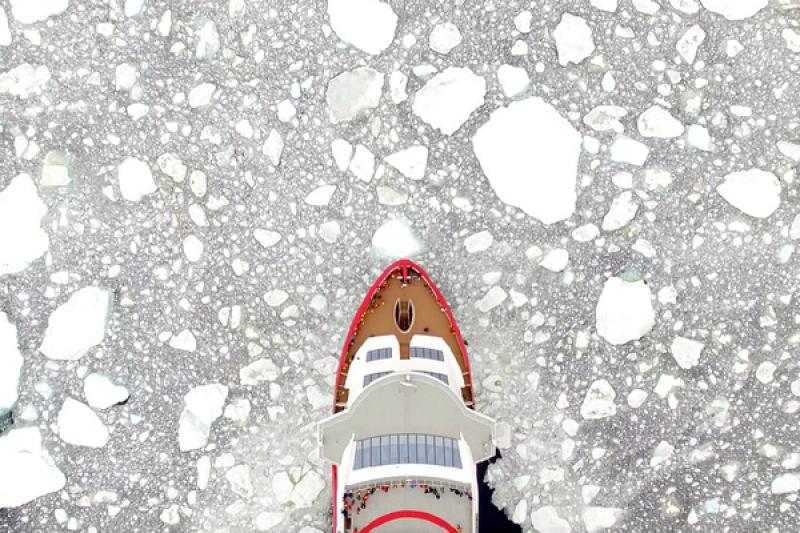
According to scientific journal Advances in Atmospheric Sciences, sea ice in Antarctica dropped to a record low of 1.9 million square kilometres in 2022 from a record high of 12.8 million square kilometres in 2014.
Meanwhile, cruise researcher Dr Jennifer Holland reported the number of cruise ships sailing in the region increased by 48% between 2012 and 2018.
Elsewhere, the vessel directory of the International Association of Antarctic Tour Operators found more than 50 different cruise ships were approved to sail in Antarctica between 2022 and 2023.
"According to a study carried out in 2010, cruise passengers produce, on average, eight times the pollution of a person in a city," Holland told TTG. "So one passenger in the region was equal to three cars in terms of CO2 emissions.
"Overall, there’s a lot more negatives than positives – depending on the region – when it comes to consumer polar exploration, and the impact it has on the environments."
Holland said the primary negative implications of sailing in both the Arctic and Antarctica were air pollution, sea pollution, the impact on marine wildlife, fuel pollution and waste.
"A particular problem in the Arctic is marine welfare and ships hitting them because of all the whales and the sea life," Holland continued.
"I always thought they only got hit if they were old or sick, but actually that’s not the case – the ships go quite quickly now so all animals, despite their age, are at risk."
According to Holland, on one particular day last year, there were 42 ships in Antarctic waters. "That’s not sustainable," she warned.
Another potential risk brought by consumer sailings to polar regions, Holland added, is the lack of understanding by cruise companies when it comes to the geography of the environment.
In 2007, Liberian-registered cruise ship Explorer – which, at the time, was commissioned and operated by Swedish explorer Lars-Eric Lindblad – became the first vessel of its kind to sail the Antarctic Ocean, and also the first of its kind to sink in the Antarctic Ocean.
According to a report published by the Antarctic and Southern Ocean Coalition (ASOC) following the incident, the vessel was carrying 48,870 gallons of diesel and 317 gallons of gasoline when it sank.
"There’s a lot of risk of huge environmental catastrophes if there was a problem with a ship, such as Explorer, which is still causing problems with discharge," Holland said.
However, there is an argument, Holland continued, that cruise lines give consumers the opportunity to see the destinations first-hand which, in turn, could turn them into "ambassadors for conservation" in these areas.
"But to be honest, the research doesn’t stack up," she continued. "A lot of people, particularly cruise tourists, are not very interested in sustainability, but the mood is shifting.
"Another study found 59% of Antarctic cruisers thought their travel didn’t impact climate change, and only 7% offset their emissions. So more education needs to go into offsetting emissions and how consumers impact these destinations."
Agents will play a crucial role in maintaining this shift towards sustainable travel, Holland believes, by "simply starting the conversation" with their clients.
"The cruise lines all have really savvy information on their websites, and agents could utilise these marketing materials to talk about offsetting emissions."
The importance of furthering consumer knowledge of sustainable travel to these regions was echoed by Hurtigruten’s UK and EMEA general manager Anthony Daniels, who said the brand "understands the challenges" around polar exploration.
"That’s why we are very front and centre about our decisions to travel there," he told TTG. "We don’t want to encourage mass consumerism. We make sure that when clients are in these environments, it’s about what they leave in a positive capacity.
"The heart of our company is sustainability, so it’s factored in to every decision we make – whether it’s what fuel we use or what facilities we have onboard."
In 2019, Hurtigruten became the first company to deploy a hybrid-electric ship following the launch of Roald Amundsen. "We are now looking at how we can replicate that across the ships we’ve got in service for our coastal sailings and expedition itineraries," Daniels continued.
He said it is not "just about taking a holiday" when travelling in these destinations, but rather about learning how the company can support the future of sensitive environments.
Daniels said Hurtigruten achieved this by sending out a science boat to collect water and plankton samples each time a consumer expedition is carried out.
"All of this information is so valuable for how we make travel to these areas sustainable in the future for everybody and future generations," Daniels said.
In 2021, the line launched its second hybrid vessel, Maud, from Dover following a fresh multimillion-pound investment. The vessel is powered by biofuel produced without palm oil, which reduces its CO2 emissions by up to 80%. It can also utilise shore power facilities in ports to eliminate emissions while docked.
Daniels said the key to promoting sustainable polar expedition cruising lay with travel agents. "We do a lot of engagement with our agents and customers," Daniels said. "Our guests are very conscious about going to these places, so we’ve got to make sure that they’re proud of what they’re doing and what they achieve.
"We want them to be the advocates. We want them to be the game changers for the industry."
Elsewhere, Peter Shanks, managing director UK and Ireland for Silversea, said it was the line’s "mission" to deliver holidays in a responsible way. "We work collaboratively with different organisations around the globe to ensure we exceed regulations related to environmental impact," he said.
"When sailing to Antarctica and the Arctic, we operate under strict environmental permits and independent verification of compliance requirements that allow us to explore the polar regions in the safest, most responsible way to minimise our impact."
Wassim Daoud, Ponant head of CSR and sustainability, said the line had invested more than €1 billion in building a fleet of ships with the "highest standards" of sustainability credentials.
"The more technologically advanced the equipment, the less it pollutes," he reasoned. "Today, the company’s smaller capacity – 160 staterooms per ship at most – limits propulsive power and reduces the quantity of fuel and emissions."
Ponant is also working on its 14th ecologically minded ship, focusing on how to reduce the vessel’s whole life-cycle impact on the environment at all levels, including atmosphere, discharges into the sea, micro-plastics and noise radiated into the water.
"Furthermore, we make every effort to ensure that our activity takes into account the biodiversity and cultural heritage of the zones visited," Daoud added. "And regardless of the destination, each disembarkation follows a rigorous protocol. This approach brings a dedicated team into play, ensuring a limited impact on the places visited."
The big question
So, despite cruise lines’ protocols to ensure sailing in these regions is as safe as possible, is it enough to justify the continuation of consumer cruising in Antarctica and the Arctic? "I think companies and agents should still be selling holidays to the Arctic and Antarctica," Dr Holland concluded.
"But the onus is on the industry to better manage the destination, which is where the conversation about caps come in to play, which will be difficult as it will drive the prices up."
Dr Holland urged the trade to "really focus" on encouraging clients to take trips to the regions "sooner rather than later" before more limits to the size of cruise ships come into force.
"We’re so aware of the impacts we are having on the planet, but it is really difficult. People still want to travel to these so called ‘last-chance destinations’ – and there is a market for it."
Travelling the world, for many, is one of the unique joys of modern times. But if we are to continue to discover the far reaches of the globe for ourselves, trips to endangered locations – such as the Arctic and Antarctica – must be sold and operated in a responsible way, with sustainability and offsetting measures at the forefront of companies’ minds when promoting the trips.