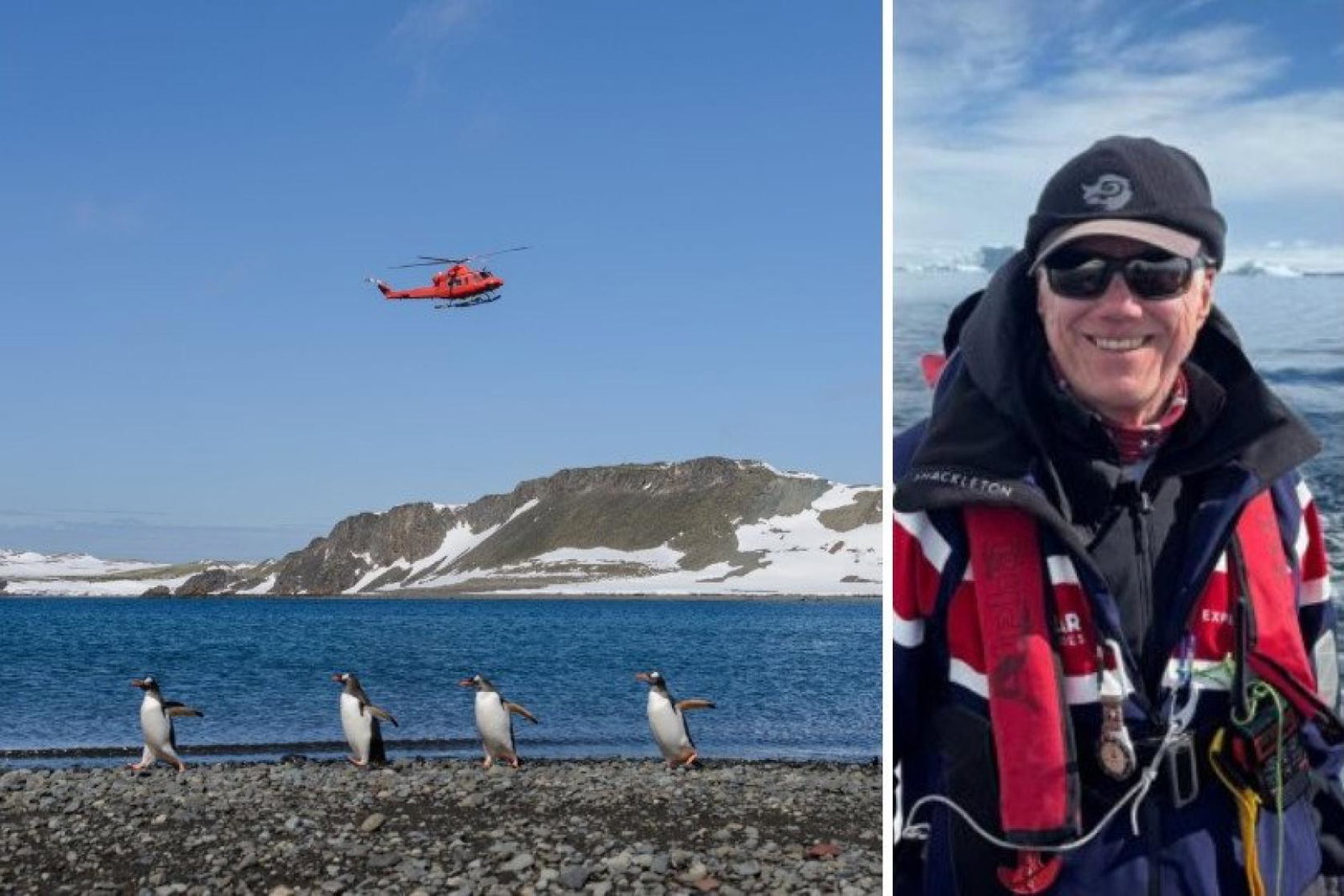
Speaking to TTG ahead of his company’s merger with Danish firm Albatros Expeditions this week, McKeon explained how there is “a strong movement” within the Antarctic Treaty Parties to move away from helicopters.
McKeon stressed he was not speaking in his capacity as chair of the International Association of Antarctic Tour Operators (IAATO), nor with his Polar Latitude Expeditions' hat on. “I can tell you there is a strong movement from some governments within the Antarctic Treaty Parties to move away from helicopters. The helicopters are a very tricky subject,” said McKeon.
He added the Polar Latitude Expeditions team is “not a big fan of submersibles” either, adding: “We think they're all nice and but they distract us from the core of what we really want to be. I'm just saying that the Antarctic Treaty Parties who actually governs the operations in Antarctica is that there's a movement towards banning helicopters.”
Twelve countries initially signed the Antarctic Treaty in 1961 which 46 other countries have agreed to since then. The UK is one of original signatories of the treaty. If a ban around the use of helicopters in Antarctica came into force only some expedition cruise operators would be impacted.
Expedition cruise lines sailing with helicopters onboard include Quark Expeditions on the Ultramarine and Scenic on Scenic Eclipse I and II. In 2022, when Silversea acquired Crystal Cruises’ Crystal Endeavor, it soon announced it would replace onboard helicopter and submarine facilities with new suites.
On Polar Latitudes’ imminent merger with Albatros, which will see the combined fleet capacity “quadruple” with the addition of three more vessels from Albatros, McKeon said: “When I started Polar Latitudes almost 15 years ago now, one of the things that I wanted to focus on – and I've been around a long time – is when you start a company, you need to stay focused on what your core product and mission is and not get too diverse.
“Our plan was to stay as Antarctic operator and do one thing and do it better than everyone else. That was our core mission. Of course, that served us very well.”
However, he added: “But the economic realities of this business are that you can't survive running one ship in Antarctica only. The cost and the overheads and everything just get too great.”
UK market focus to increase
McKeon said Albatros would give the combined polar operations fleet “real strength” in the Arctic. The combined polar operations fleet will consist of Ocean Albatros, Ocean Victory, Seaventure and Ocean Nova. “This [merger] is a great opportunity for us to do that expansion while also maintaining what we always wanted to do,” McKeon insisted.
He added Albatros has “a very strong” charter business, while Polar Latitudes brings “a stronger retail and travel agents business”. “That's where I think the merger works very well from a commercial standpoint,” he said. “But going forward, our anticipation is that about 50% to 60% of our business will come either through direct clients or through the travel trade.
“The other 45% to 50% will be charters. My message to the travel trade and some of the top travel trade partners in the UK is that we will continue to be the company that is the easiest to work with.”
McKeon pledged to grow the trade and “place a lot more emphasis on the UK market”.
Around 55% of Polar Latitudes’ bookings come via the US market, with around 20% to 25% of business being sold through the UK. “The UK market is a market that we like to work in,” he continued.