I use my jacket to wipe a circle into the fogged-up train window before pressing my forehead against it, eager to not let any waterfalls peeking through the mountains pass me by. The rain hasn’t stopped since last night and it’s the kind that soaks right through to your skin no matter how good your waterproof gear is. With a sudden jolt, the train gradually picks up speed – its gears meshing with the metal rack beneath me, gripping firmly to prevent slipping with each rotation. This is a 150-year old mechanism I am particularly grateful for on a slippery day like today. It’s my first time on a cogwheel train, and we’re heading up one of Switzerland’s steep mountains, where somewhere up between the clouds lays Rigi Kulm.
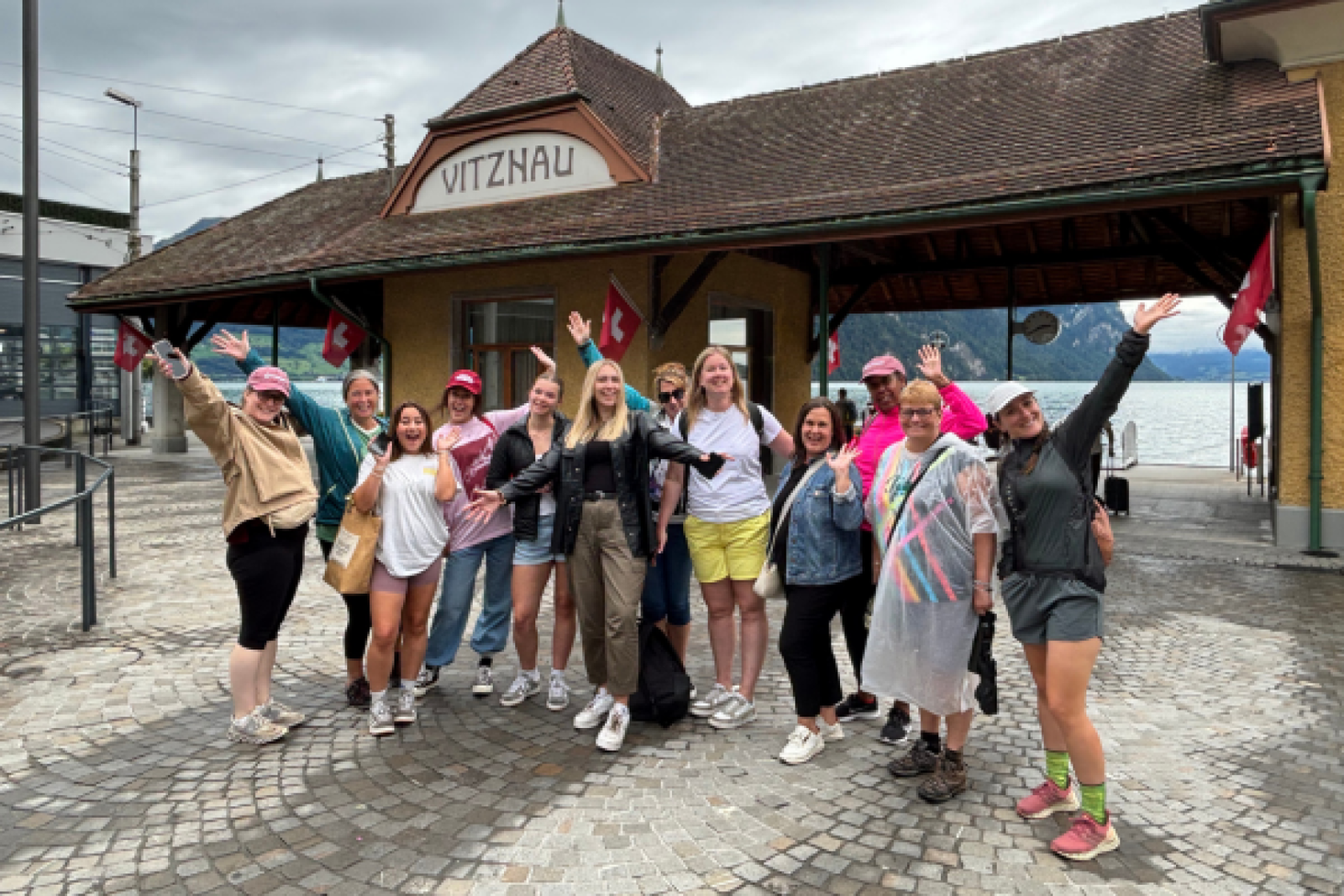
Ingrid, our outdoorsy Intrepid local guide, leads nine TTG Sustainable Travel Ambassadors in Training and me on a hike up to the summit of Rigi – we’re on the operator’s first-ever no-fly fam trip and are whizzing our way across France and Switzerland over seven days. “Every day is a mountain day,” says Ingrid with a smile that comes from years treating the mountains as her office. Before I even have a chance to wonder whether I can make it to the summit, we’re already on top. The panoramic view of the beautifully separated Lake Zug and Lake Lucerne will leave even the least enthusiastic hikers smiling and grateful they made it.
Cheese please
What I’m ready for, after all the hiking, is a visit to Alp Chaserenholz farm. Located just 20 walking minutes away from the summit of Mount Rigi, this traditional alpine hut isn’t just a dairy farm; this is a family home. The shelves are crammed with books and photo frames, movie cassettes and ornaments that make it all look chaotic, yet familiar. It feels just like stepping into my Baltic grandmother’s home, the kind of place where kicking off your shoes feels mandatory.
Lunch is waiting, with irresistible, smoky aromas of an Alpine BBQ filling the room. The organic and fresh food is produced right here on the farm, with each bite drawing me in for the next. I can’t resist going for seconds.
After the well-deserved feast, our host, Daria, leads us into the cool cellar where the cheeses are made. Founded by Franz Toni Kennel at just 19, Alp Chaserenholz now produces 12,000-20,000kg of organic cheeses every year and is favoured by locals and visitors from across the region, eager to experience the authentic Alpine flavours.
As we explore the cellar, Daria shares more stories of her life on the farm – tending to animals, making cheese and following traditions that have been passed down through generations. Her favourite part of the day, she tells me, is feeding the pigs at 5am which is a ritual that sets her day off on the right track. Daria introduces our group to a slower pace of life, and I can’t help but live vicariously through her.
In true Swiss hospitality, she sends us off with a selection of the farm’s best cheeses as we journey to Lake Lucerne, where we board a boat from Vitznau Station to Lucerne’s old town.
Lakeside living
The skies are clear now, with the sun piercing through the mountains, reminding me of Lausanne where our Swiss adventure began.
The picturesque city of Lausanne, situated on the shores of Lake Geneva, greets us with its perfect mix of culture, history and architecture that speaks of centuries past. As we wander the cobbled streets, we pause to admire Lausanne Cathedral. Standing at the heart of the Old Town, Switzerland’s largest Gothic church serves as the perfect starting point for exploring the city, allowing for easy connections to all must-visit sights.
Next morning, a short ride on a double-decker train brings us to Chillion Castle. It strikes me as a picture-perfect castle surrounded by misty mountains, with its walls and high towers rising straight out of the shores of Lake Geneva.
I wander off on my own and end up in some of the dimly lit basement rooms. The atmosphere is a little eerie and for a moment it feels like stepping back in time.
In the past, the corridors I walk were used for storing supplies and weapons before being turned into a prison around 1290. With no one else around, the ominous silence makes me question whether I am walking with the souls that never truly escaped. I opt for the stairs before I get my answer.
Today, the castle welcomes more than 140,000 visitors every year, making it one of Switzerland’s most visited landmarks.
A shore thing
Lausanne is also the perfect choice for sports fans, being home to the headquarters of the International Olympic Committee and its renowned Olympic Museum. Boasting interactive exhibits, artefacts and memorabilia, the Olympic Museum is a great stop for clients travelling as a family.
After exploring the history of Lausanne, we discover its Mediterranean side. Walking downhill from the museum, we reach the Ouchy lakefront, known for its picturesque lakeside walkway and breathtaking views of the surrounding mountains.
Six Swiss Francs grant us access to Bellerive-Plage – an outdoor leisure centre with numerous swimming pools, complimentary sunbeds and, most importantly, access to the shores of Lake Geneva. The spot is evidently favoured by locals, with children splashing at the edges and groups of people lounging across the green lawn.
Although I haven’t packed for the occasion, I can’t resist dipping my toes into the clear water – mostly just so I could say I’d done it. Looking up, across the lake behind the hazy mountains lies France, where our Intrepid European rail adventure both started and will end.
Bonjour and au revoir
We travel to and from Paris by Eurostar. Our city exploration here starts with the Hidden Marais Urban Adventure Tour, led by local guide Cecilia, who leads us through the streets of the historic district, known since medieval times as “The Swamp”.
Le Marais is famous for its “petit hotels”, owned by aristocrats centuries ago. These elegant Parisian mansions were built in the surrounding areas of the royal court by wealthy families wanting to hide their fabulous courtyards behind tall walls. Many have been repurposed and survive as museums or galleries today, attracting history buffs from all over the world.
Today, Le Marais thrives as one of Paris’s most diverse neighbourhoods and is home to numerous designer shops, trendy restaurants, a welcoming LGBT+ district and the city’s famous Jewish Quarter. The latter, Cecilia says, is a must-visit for those looking to try the world’s best falafel, served at L’As du Falafel.
Although, I can’t personally confirm or deny whether it lives up to the hype, judging by the length of the queue, the verdict might already be in. Our dinner plans take us to Le Reflet for a farewell dinner, where we’re served a three-course Parisian feast by friendly locals with learning difficulties before we retire for an early night.
So, as we board our return Eurostar train, now bound for London, the rhythmic sound of Switzerland’s cowbells and the rich cheese flavours still linger in my memory. This further cements that travelling by rail doesn’t just move you from A to B – it’s about the stories and connections we make along the way that enrich the journey.
As Wanderluxe's Lisa Russell, one of the TTG Sustainable Travel Ambassadors in Training says, “Intrepid’s European rail itineraries really enable you to see so much and allow you to get under the skin of a country with great people,” – and I couldn’t agree more.
Book it: Intrepid’s eight-day Best of Switzerland adventure starts from £2,915pp; click here to learn more