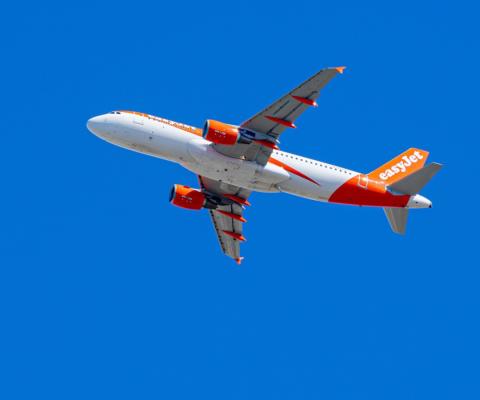
The budget carrier had pinned its new roadmap to a new set of science-based targets, which seek to achieve a 35% reduction in emissions by 2035 and 78% reduction by 2050, with residual emissions addressed through straight carbon removals.
This will be supported by a fresh focus on new low or zero carbon technologies, including zero emission aircraft, and a pledge to work with partners such as jet engine manufacturer Rolls Royce.

On Monday (26 September), easyJet said it was embarking on the next phase of its journey to net-zero emissions by 2050, claiming it is already a "highly efficient" operator with emissions around 18% lower than the global average for airlines operating narrow-body fleets.
"Investments will transition away from offsetting to focus on driving in-sector emission reductions to deliver our net-zero roadmap," said easyJet, highlighting a number of "levers" on which it would focus its efforts. These include:
- Renewing its fleet to focus on Airbus neo-family aircraft – easyJet currently has 168 on order through to 2029;
- Delivering operational efficiencies such as fuel savings through optimising how its aircraft descend and by taxiing using a single engine;
- Transitioning to sustainable aviation fuels, which easyJet says it will use "at scale" in line with guidance from Refuel EU as a minimum;
- Pursuing airspace modernisation – easyJet says "at least" a 10% reduction in emissions could be possible by 2035 by implementing the Single European Sky initiative and modernising UK airspace;
- Investment in zero-carbon aircraft, adopting new technologies early and transitioning its fleet where and when zero-carbon options are available and "commercially viable"; and
- Removing any residual emissions to make its efforts up to 100% by 2050 (net-zero) through carbon removal technology
’Ambitious roadmap’
EasyJet chief executive Johan Lundgren claimed easyJet had become the first low-cost carrier "worldwide" to have a validated science-based target for a further 35% reduction in carbon emission intensity by 2035.
"Since 2000, over a 20-year period, we have already reduced our carbon emissions per passenger, per kilometre, by one-third, so this marks a significant acceleration in our decarbonisation," said Lundgren.
Lundgren said easyJet’s "ambitious roadmap" would zero-carbon emission technologies would be at the centre of its journey to net-zero, adding he was pleased with engine partner Rolls Royce’s commitment to testing hydrogen-powered engines.
"We will be implementing our roadmap step by step in the years to come, helping to ensure more sustainable travel is accessible to all for the benefit of the next generation and our planet," Lundgren added.