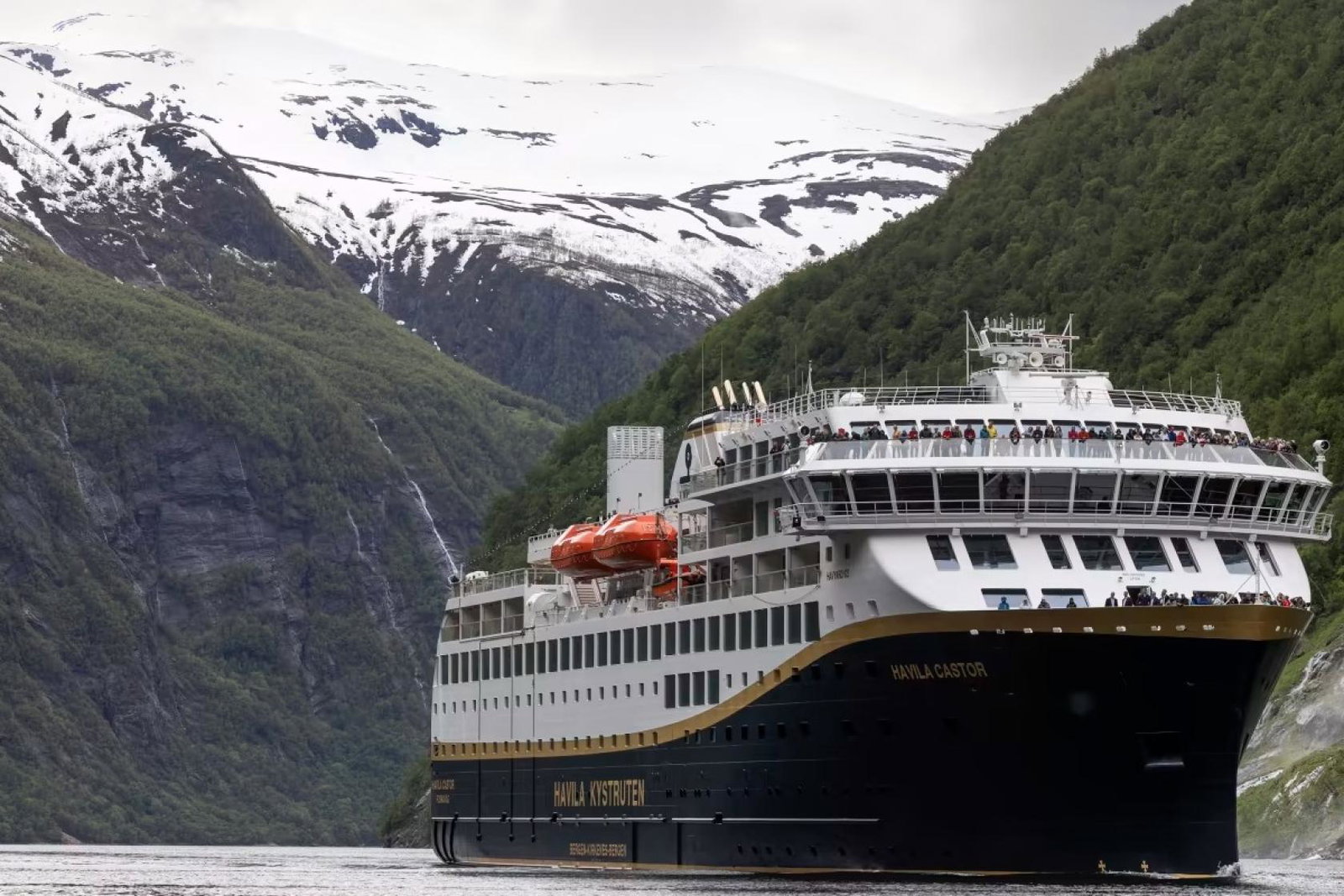
The line’s newest ship Havila Castor completed the sailing through the Geirangerfjord in Norway with a battery pack of 6.1 Megawatt hours (MWh) – the world’s largest battery pack on a passenger ship.
Billed as “ships for the future”, Havila’s fleet can sail up to four hours using just battery power. The ships also use liquefied natural gas meaning CO2 emissions are reduced by 30% and NOX emissions by 90% compared with similar vessels that use fossil fuel, the line said.
Passengers onboard the ships are also urged to be mindful of their energy usage, with guests onboard Havila Castor encouraged to be aware of mobile charging, light and heating in the cabin. The ship’s hotel operation also reduced its consumption prior to switching to battery power for the sailing.
Sandra Ness, head of climate and environment for Havila Voyages admitted: “It requires some resources to cook for over 300 passengers, as well for lighting onboard and to heat the ship,” but added: “When we sail emission-free, we do everything we can to reduce the consumption of electricity, and sailing like this becomes a shared responsibility. If we are to succeed in climate, environment and sustainability, it is important that we also involve our guests onboard.”
The move follows demands by the Norwegian parliament in 2018 for cruise ships and ferries to sail emission-free in Norwegian World Heritage fjords as soon as possible.
Bent Martini, chief executive at Havila, described the sailing as a milestone. “We spent just over 60% of the battery’s capacity on this voyage. That demonstrates to us that the goal of four hours on battery clearly is achievable,” he said.
"With even more testing and adaptation of all energy use onboard, we will eventually be able to sail the entire world heritage emission-free without major challenges” he added.
Martini is now calling for access to shore power along the Norwegian coastline.
“We want to utilise our battery power even further, but to do that we rely on having in place the infrastructure for shore power to charge the ship on clean hydropower," he said.
"We hope this will be operational in selected ports of call soon. In addition, we plan for a gradual blending of liquefied biogas to replace the natural gas over time.
"This requires biogas to made available to a large enough extent to meet our needs.”