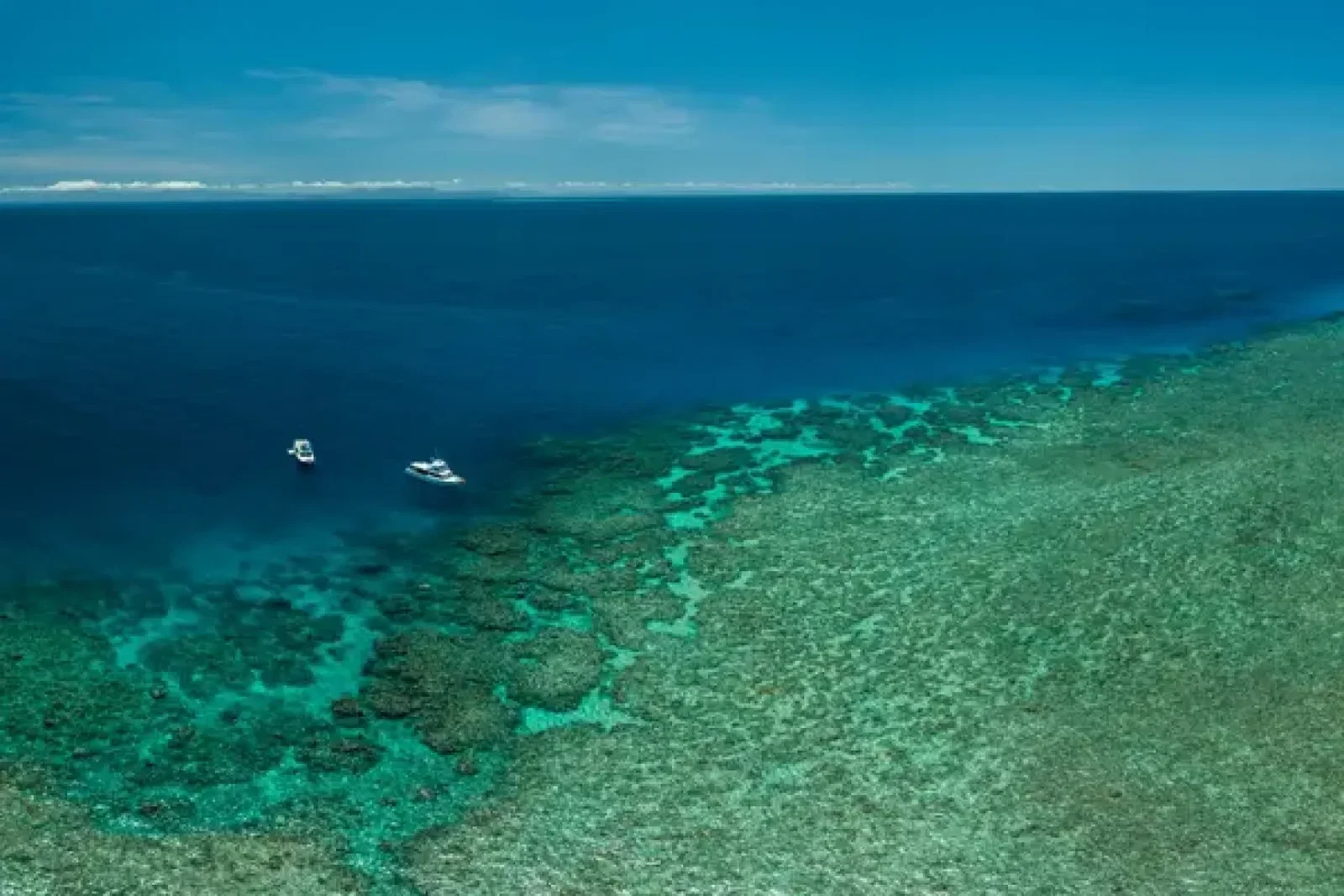
“All dead and brown,” sighs the tourist next to me on the ‘glassy’ (glass bottomed boat), as we glide over the corals on a warm February 2024 day, seemingly oblivious to the fact many coral colours simply range, naturally, from autumnal to pastel.
As the world’s largest living structure and the only World Heritage site on the planet to lie side by side with another – the vast green lung of the Daintree Rainforest – the Great Barrier Reef frequently garners attention and sparks debate. It’s long been considered a ‘bucket list destination,’ but in recent years it’s been seen, increasingly, as a place to visit before it dies. No wonder that 2017 research, published in the Journal of Sustainable Tourism, noted that almost 70% of tourists to the Reef were motivated by a ‘now or never’ mindset; that the ‘bucket’ in question was the Reef’s, rather than theirs.
Others may have reservations about visiting at all.
“It’s certainly a topic that comes up with guests, especially those who are more environmentally conscious, or who have been following news about coral bleaching and climate change,” acknowledges James Golding, global vice-president sales at Hayes & Jarvis. “There’s often a tension between their desire to see the Great Barrier Reef, on the one hand, and their concern about whether it’s the right thing to do, or whether the experience will live up to expectations, on the other.”
Some of the facts that can be relied upon when allaying such concerns are legislatively mandated. For instance, operators are only permitted to take their clients to designated sites, and no new ones have been established since 1997. In addition, less than 1% of the Great Barrier Reef – a structure that’s roughly the same size as Germany – is used for commercial purposes, and visitor numbers are strictly limited.
“For every visitor to the reef, the tourism industry pays a levy to the Great Barrier Reef Marine Park Authority – a federal government authority whose role it is to look after the reef and ensure its ongoing preservation,” explains Brian Hennessy, manager of trade & strategic partnerships for Sunlover Reef Cruises. These funds contribute not only to coral replanting, but also to research; into finding out more about what’s going wrong and how we can begin to try to put it right.
Raising standards
When I gained my Advanced PADI in 2001, the atmosphere on our liveaboard vessel was that of a party boat, with a larrikin captain who threw food scraps overboard to encourage sharks to swarm, daring us to be the first to jump into the water.
The atmosphere today couldn’t be more different, with most vessels having gained ECO-certification, thus demonstrating their commitment to sustainable practices. Operators hold a variety of books on board, encouraging travellers to educate themselves while on the journey out to the Reef (departures from Cairns can take up to two hours, depending on the dive site), and crew also host educational talks and slide shows, highlighting dangers to the Reef, as well conservation efforts.
For instance, Reef Magic has a dedicated team of storytellers, educators, conservationists and researchers (from GBR Biology), who tell the Great Barrier Reef story with a biological and First Nations perspective. GBR Biology manager Dr Eric Fisher says: “Our job is to connect clients to the reef through experience and story. The more people who see the reef and love the reef will [help] to ensure its protection for generations to come.”
These educational experiences also form a valuable reality check, particularly for those who might be of the ‘’all dead and brown” school of thought. When we see professional photos, they’ve been lit with enormous underwater lights, which heighten the vividness of water and coral alike. Oftentimes, they’ll be enhanced further before publication. Many coral colours simply range, naturally, from autumnal to pastel.
None of this denies that the Great Barrier Reef faces challenges. Sea temperatures are rising, and major bleaching events have occurred in quick succession. Violent storms have wreaked further havoc, as have outbreaks of Crown of Thorns starfish, which feed destructively on coral polyps.
But one lesson that Reef operators are keen to share is that coral can be more robust than it looks.
“The GBR is vast, has survived millions of years, is extremely resilient and is proven to have come back after significant bleaching events and cyclonic damage,” says Taryn Agius, owner of Ocean Free. Dr Fisher agrees, saying that “climate change is the greatest pressure to the Great Barrier Reef that influences the frequency and severity of tropical cyclones and marine heatwaves. We are seeing that the Great Barrier Reef has not lost its ecosystem function and is still able to recover from these disturbances.”
Understanding coral bleaching
Additionally, bleached coral is not necessarily dead. Coral is formed of clusters of animals called polyps, which are inhabited by a type of algae, zooxanthellae, which gives them their colour. When water temperatures rise, the coral gets stressed and expels these algae: hence colour loss. If the water cools down, the algae – and colour – will return. It’s also worth advising clients that water temperatures are higher near the surface, so a snorkeller or glass-bottomed boat passenger will gain a different visual impression of coral’s appearance than someone diving in deeper, cooler waters.
Of course, not every visitor to the Great Barrier Reef will dive, but snorkellers, too, should be encouraged to take part in the ‘Eye on the Reef’ citizen science programme. Accompanied by a Master Reef guide, reef visitors conduct underwater surveys, the results of which are later sent to a central system, where they can help researchers to develop a clearer picture of the state of the Reef and inherent threats to it.
Should tourists visit the Great Barrier Reef? Without a doubt – not only because it’s majestic, unique and humbling, but because seeing it and learning about it puts these qualities into context and helps travellers to make more informed decisions about their environmental impact, and contributions to climate change, no matter where in the world they are.
In a world-first, the UNESCO World Heritage-Listed Great Barrier Reef is to be nominated as the first non-human recipient for a Lifetime Achievement Award (the highest environmental honour from the United Nations Environment Programme’s Champions of the Earth Awards). The nomination is part of The Lifetime of Greatness Project, launched by Tourism Tropical North Queensland. Get involved by visiting alifetimeofgreatness.com to add your name.