It is 4.45am and I seem to have woken up in the Big Brother House. My cosy single bed is in a row of four and from a corner of the room I hear a gentle snore. Then I see the pitched pine roof and wood-burning stove and remember why my alarm went off. I’m about to go wildlife spotting in Italy’s Apennine mountains.
Joining a group of six on a Walks and Wildlife tour with Exodus Adventure Travels, I had spent the previous day hiking in some of Europe’s oldest beech forest to a remote mountain cabin in the Abruzzo, Lazio and Molise National Park. Protected by Unesco, the forest shelters rare birds and wildlife including the golden eagle, pine marten, grey wolf, European wild cat, red deer and the critically endangered Marsican brown bear.
I had no idea there were bears in Italy or that the “wild heart of Europe,” as this region is known, was so accessible. We check in at the 11-room Villino Quintilianil in the village of Pescasseroli, within the Abruzzo National Park, two hours after leaving Rome’s railway station.
Saving rare species
A century ago, bears were still hunted in Italy but a dwindling population survives, in this mountainous, forested area. Almost 33 per cent of regional land in Abruzzo is protected in national parks and reserves, making it a biodiversity hotspot. “It’s what makes us so special,” says Valerio Reale, enterprise director at Rewilding Apennines (RA).
Exodus defines rewilding as “restoring ecosystems and biodiversity, helping wildlife to return and thrive”. It can also provide opportunities for communities to diversify and create nature-based economies, including tourism. The operator partners with RA as part of its Nature and Carbon Corridors project.
RA has facilitated the reintroduction of the native Apennine chamois and griffon vulture. Reale says that since the vulture was re-introduced 30 years ago, numbers have increased to around 70 breeding pairs, drawing nature enthusiasts to the area. It is hoped that the next bear census, beginning this year, will show an increase in the population of Marsican bears. “It’s a critical time because after many years a small number of bears are starting to migrate from the core area to neighbouring parts of the park,” says Reale.
Exodus’s pledge to rewild 100 sq metres of land in the park for every booking made (to anywhere in the world) has so far funded activities across 915 hectares. In addition, all profits from the Walks and Wildlife tour support the work carried out by RA. It is a shining example of a sustainability partnership in action and demonstrates the important role agents can play in encouraging nature-based travel experiences.
Wildlife corridors
The six-day itinerary combines guided hiking in the Abruzzo mountains with wildlife tracking, sunrise and sunset bird- and wildlife-spotting. Hikes will take us into two of the five wildlife corridors being developed by RA. On our first morning RA’s scientific coordinator Filippo Castellucci drives us to the medieval village of Anversa, at the heart of the Abruzzo, Lazio and Molise National Park where we meet a local farmer, Matteo.
Today, Matteo will take his horses to high grazing pastures for the summer and he has invited us to follow him around the escarpment of the Sagittarius valley. Led by the herd, and with distant views of snow-dusted peaks, we embark on a steady uphill hike along a path lined with clumps of sage and thyme and occasional wild orchids. “Forza, forza!” shouts Matteo, to keep the horses moving. Matteo’s land straddles one of the wildlife corridors being developed to allow safe movement of bears and other wildlife throughout the region’s park.
Kasia Morgan, head of sustainability at Exodus Adventure Travels, says RA’s re-wilding work must also support the livelihoods of those who share the landscape. “Through the fostering of ‘bear smart communities’ Rewilding Apennines is building a culture of coexistence where people are empowered with the knowledge and tools to live alongside wildlife, including the Marsican brown bear.”
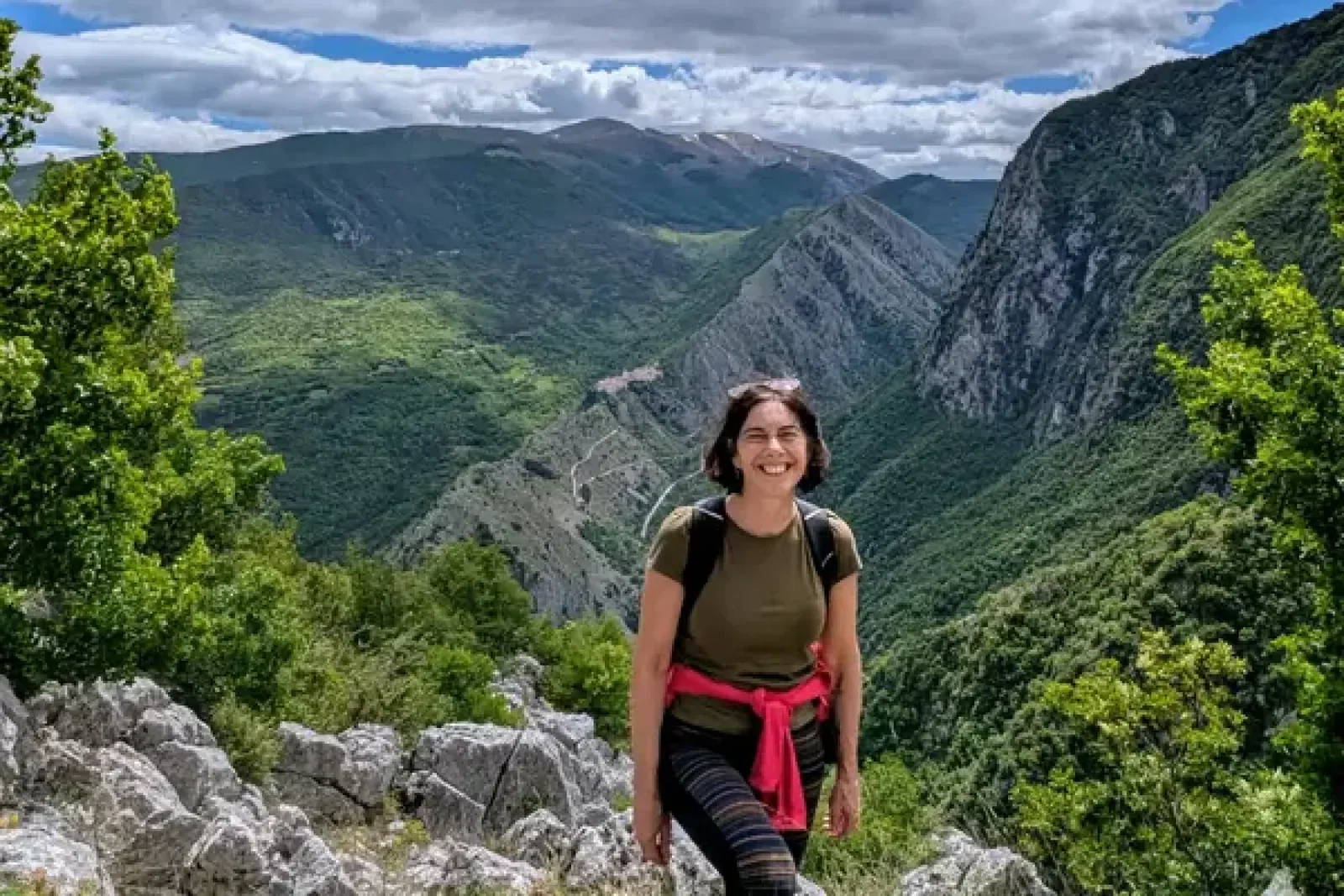
At 8.1 miles our hike up the Sagittarius gorge is the week’s longest and steepest, but the scenery, scents and views are spectacular. And it gives us an opportunity to walk off the cheese and cake consumed at breakfast.
Gourmet fuel
We are very well fed – whether at the hotel, village tavernas or by a producer showcasing farm-produced cheeses, honey, vegetables, cider and wine. Multi-course dinners are served at Villino Quintiliani, and each morning we waddle off from a buffet loaded with home-made bread, jams, meats, cheese, fruit and a donut-shaped breakfast cake, called ciambellone.
Our night at the remote Terraegna hut gives us the chance to engage in some sunset and early-morning wildlife spotting – when bears and wolves are at their most active – and to experience the extraordinary beech forest. Trees along the canopied paths are clothed in lichen and the fantastical hoof fungus protrudes from trunks like flying saucers. The silvery fungus has useful properties. “Shepherds used it as portable kindling for fires,” says Filippo.
We pause by one of the infrared wildlife corridor cameras used by WA to monitor activity and species populations and Filippo points out wolf excrement and signs of bear presence on tree trunks and in the hair on wire fences where bears have scratched their backs.
The mountain hut’s cocooning effect is felt by all. That evening, in the warm and cosy kitchen-cum-dining room, we tuck into a foraged fennel and orange salad followed by steaming plates of beef sausage poached in white wine. By 10pm we’re tucked up for the night in our “Big Brother” bedroom.
Next morning, before dawn, we set off for a view point above a steep-sided valley that dips and rises to the ridges of the Apennine chain. Within minutes of leaving the refuge Filippo spots a pair of wolves and a fox in the shadows. At the edge of the valley, we wait and watch, the silence broken by the drumming of a white-backed woodpecker and the coo of a tawny owl. Bears remain elusive but as light creeps into the valley we observe two graceful red deer through binoculars.
We couldn’t be happier, and with that sighting, we decide to head back. Our host at the refuge, Debora, has baked ciambellone for breakfast.
Book it: Exodus Adventure Travels’ six-day Italian Apennines: Walks and Wildlife, costs from £1,449pp, excluding flights and including B&B accommodation, transport, activities and some meals. Departures on September 21, 2025 and on May 17 and September 20 in 2026; exodus.co.uk