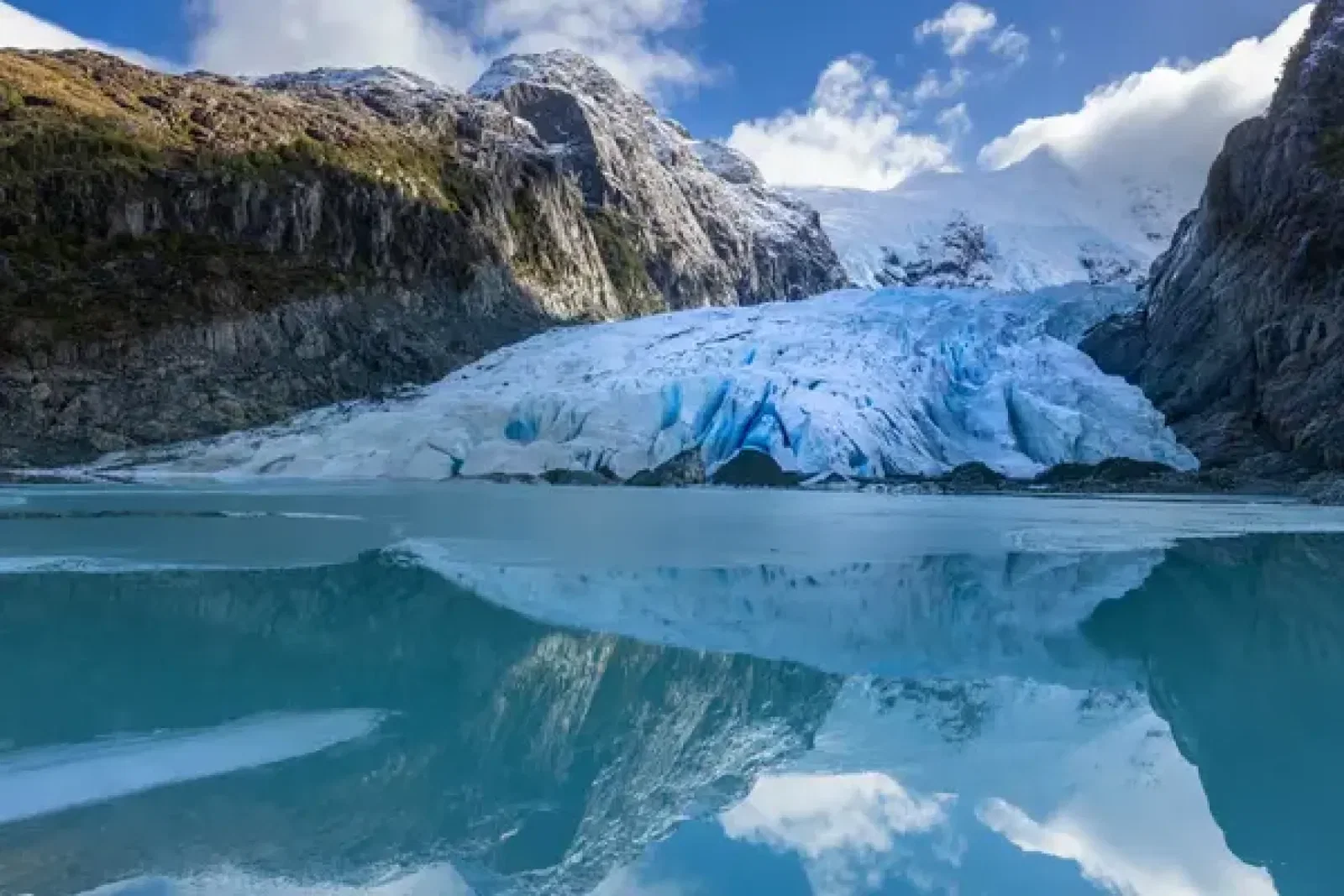
As our ship creeps around the corner past towering granite cliffs streaked with ivory trails of tumbling waterfalls, there’s a collective gasp as we spot a wall of teal-tinged ice blocking our way.
Rising up a dizzying 200ft, roughly hewn and scarred by deeply chiselled crevasses, this is the Garibaldi Glacier, the frozen crown jewel of the Chilean fjords that carves a 10-mile path from the Patagonian ice fields before tumbling at glacial speed into the Beagle Channel.

Tucked into South America’s southwestern flank where these narrow waterways spread out like spiny fingers, Chile’s fjords are relatively unknown and somewhat overshadowed by their grander counterparts in Norway and Alaska. The hallmarks of these fjords are their history and remoteness.
While best explored on cruises, we don’t see any other ships during our two days here. In Alaska and Norway, you can expect to cross paths with a fair number. One reason for the sparse number of ships is that this isolated region is difficult to reach, especially for British travellers.
I’d flown into Peruvian capital Lima with my husband two weeks earlier to join Silversea’s newest ship Silver Ray, which debuted last June.
Our South American adventure takes us southwards down Chile’s west coast. Then we switch oceans from the Pacific to Atlantic before heading north to Buenos Aires from where we fly home.
BREAKING UP THE VOYAGE
Our 20-night sailing is part of a 71-day South American odyssey and, of the 647 passengers on our voyage, nearly 200 have signed up for the entire duration. Silver Ray holds a maximum 728 passengers, and every suite on our sailing is taken due to a high number of solo travellers.
Hotel director Daniele Franco explains that while Buenos Aires to Rio de Janeiro is the most sought-after part of this voyage, our Chile sector is popular among those who have never been to South America, especially as Silversea clients can opt for side trips.
Instead of staying onboard for the four-day transit between Ushuaia and Buenos Aires, some disembark in the Argentinian city for a five-day journey to the Iguazu Falls, while others depart in the south Chilean city of Punta Arenas to explore Patagonia. Both groups rejoin Silver Ray in Buenos Aires.
“This is a cruise for guests who have never been to this part of the world and for many, once they’ve done this, they don’t tend to repeat it,” Daniele explains.
He highlights how easy it is to explore South America by sea, adding: “The ship becomes the main island, where everyone feels safe. There’s nothing to worry about, no travelling to arrange. We organise everything, which makes it easy and comfortable.”
I can vouch for that. As Silversea’s newest Nova class ship, with an asymmetrical design that brings a feeling of space and light throughout, Silver Ray makes a chic and opulent home with pampering butler service, top-notch restaurants and liberally flowing champagne.
This is a ship that never feels crammed, even on sea days, when the pool remains deliciously uncrowded and there’s always a plentiful supply of sun loungers.
A CULINARY JOURNEY
Silver Ray has eight dining venues featuring Japanese, French and Mediterranean cuisine, although the constantly changing menus of the Salt Kitchen, with South American specialities such as empanadas, ceviche and stews make this a firm favourite of ours.
The beautiful Marquee, with its lunchtime poke bowls and Hot Rock evening barbecue, draws us back constantly, while the Silver Note supper club, where we tuck into tapas dishes accompanied by smoky jazz numbers from a pianist/singer combo, is so popular guests would be wise to book ahead of their cruise departure. It is so busy on our voyage that we have to be wait-listed.
Restaurants are complimentary, apart from French gourmet La Dame and Japanese venue Kaiseki, which carries a charge for evenings (though lunch is free).
The air of camaraderie makes it easy to strike up conversation with Silver Ray’s well-heeled collection of largely American guests, though there’s a healthy sprinkling of Britons who are the second-largest group at nearly 100 strong.
Sea days fall into a comfortable rhythm of browsing the well-stocked library, harnessing artistic skills at watercolour classes or attending excellent talks in the main theatre, which help to bring the region’s colourful history alive.
DARING EXPLOITS
Explorers, buccaneers and conservationists have all beaten a path here, and as we walk the mural-painted streets of Valparaiso, Chile’s second city, we learn how it was besieged by privateers, including Sir Francis Drake who arrived on Golden Hind in 1579 to plunder its riches.
The rise and fall of the city’s fortunes is linked to earthquakes and tsunamis which overshadow a region sitting on a tectonic belt of volcanoes known as the Ring of Fire. However, it was the opening of the Panama Canal in 1914 that dealt the harshest blow, cutting lucrative trade to South America’s port cities at a stroke.
Further south is the Chilean Lake District, whose snowy peaks and German heritage give it an Alpine feel, acting as a fitting precursor to the fjords, although my first impression of these inlets leaves me slightly underwhelmed. It’s only as we approach the glaciers that the scenery takes on a more dramatic turn more befitting the region’s history of exploration and discovery.