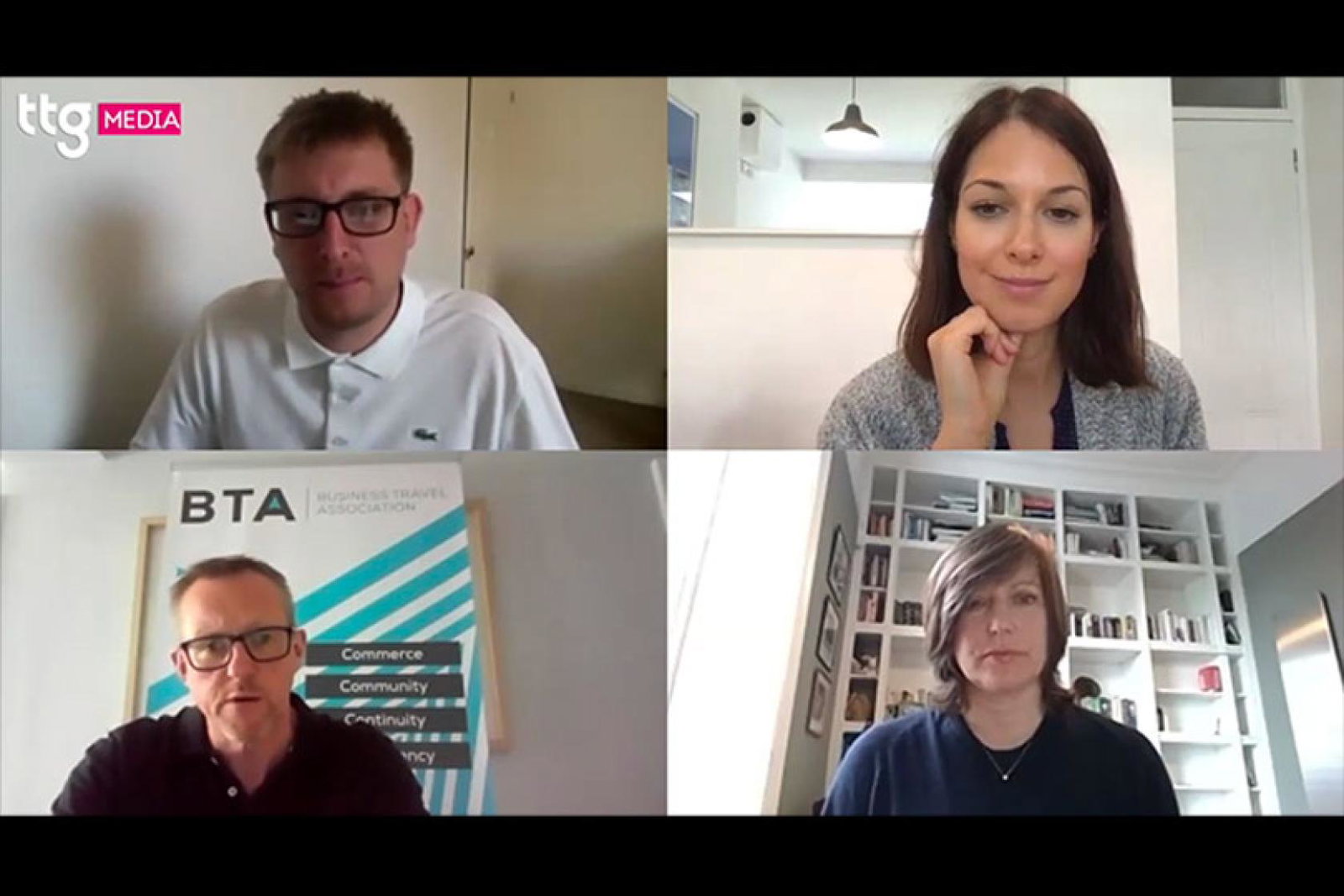
Clive Wratten, chief executive of the Business Travel Association, Maria Baty, managing director of Altour, and Tom Davis, Click Travel’s director of customer support and compliance, joined the debate, which was hosted by TTG acting features editor Abra Dunsby.
TMCs were the first to experience the Covid-19 fall-out and Wratten said 45% of BTA members had between 50% and 70% of staff furloughed, with a further 24% furloughing 71-90% of employees.
Only two members had received the money from their Business Interruption Loan, while another 12 were in process. But others were experiencing delays in banks’ responses, he said. Another 35 members had so far not chosen to apply, and the rest did not qualify because their turnover was too high.
“Loans have been pretty hard to get hold of and it’s more the exception than the norm that people are seeing money come into the bank,” he said.
The BTA is lobbying the government to get a business rate holiday for TMCs, similar to the one available to the retail trade.
“The argument being made is we are travel agents and it therefore should apply. They came back and said, ‘we define retail as people with footfall, so if you’re not on the high street, sorry’; but I know of one TMC that managed to get it by contacting local government,” said Wratten.
Baty said Altour’s staff were 70% furloughed. “Corporate travel is always at the sharp end. Bookings started to dwindle once China started [implementing measures against coronavirus], whereas on the leisure side people continued with their holidays.”
Davis added: “From a revenue and bookings perspective it’s looking, to be honest, quite bleak. We only have 5% of our previous volumes and revenues.
“The 5% is pretty much key workers [travelling domestically] and emergency housing. It’s a very big challenge because it’s not clear which hotels are open and it’s all very manual work.
Key workers aren’t just frontline NHS staff; it’s people maintaining things like railways and roads. “We’ve furloughed 75% of our people and kept a core of 60, but we’ve topped up our employees’ pay to 100%.”
Broken chains
The panel spoke of difficulties with some suppliers. “There have been some frustrations about people just stopping and not having conversations in terms of money flow coming into our chain,” said Wratten.
“We are in this together and we need to look after the business travel supply chain. Just to stonewall people right now is frankly the wrong way to go about it.”
Airline refunds were a frustration, Wratten said, but added UK airlines “had always been pretty co-operative”.
He said the BTA was lobbying Iata for a defined timeline for refunds via GDSs – “perhaps eight weeks for corporate clients”.
Davis said low-cost airlines had generally responded well to refund requests, but added: “We are still struggling with some long-haul carriers.”
Baty said things were “starting to improve, but the time lag is often a 12-week wait or longer”.
Wratten said he knew of 18-20-week waits for refunds, but added: “I guess the issue here is airline staff have been furloughed.”
Train companies were another bugbear. Baty said booking platform Trainline was charging for cancellations, but Evolvi was not. “It’s causing some challenges for clients,” she explained.
Wratten added: “What’s disappointing about Trainline’s position is that it’s just for the corporate sector. It sticks out like a sore thumb with all the airlines not charging and them arbitrarily charging the corporate sector.”
TMCs, like many others, are using video conferencing apps, but Wratten said this reinforced the desire for face-to-face contact when travel resumes. “Video conferencing is great, but I miss being in a room with people, it’s just not the same.”
Baty predicted a “very, very slow” recovery. “In the short term, we won’t see any uptrading for at least until the end of this year,” she said.
However, Wratten said: “I’m less pessimistic going all the way out to five years, in 12 months we may see some returns though not to the same levels as before.”
Davis predicted “more business early next year”, particularly from the domestic construction sector.
His TMC has produced Click Care, a client package showing what future travel will entail, such as airport protocol and off-limits areas.
Baty added: “A lot of our work has been on duty of care. It will be essential for TMCs to be strong in that area when we come out of here.”
Wratten concluded corporate travel was vital for the recovery. “Business travel is not just about signing a multi-billion-pound deal for a hedge fund – it’s about building the world and keeping it safe. It’s really important we get back.”
Tune in to the next Agent Matters on 19 May on the TTG Facebook page.