







How can you tell if a hotel is making a genuinely positive local impact? These four hotels set the gold standard for how hotels should be constructed or renovated, how they run their day-to-day operations and how they interact with the local community. Read on and be inspired!
Jaya House Hotel in Siem Reap
This boutique 36-room hotel in Siem Reap, Cambodia is not just a TripAdvisor fan favourite, it also makes a genuinely positive local impact.
Its staff are employed full-time, not seasonally, and they are 100% local to Siem Reap and the surrounding villages. The only non-Khmer member of staff is Christian De Boer, owner, managing director and general manager. Staff are employed from impoverished backgrounds, which include the victims of female trafficking, corruption, drugs and alcoholism
The hotel is 100% single-use plastic-free. Not one piece of single-use plastic will be found in property, from the kitchens to the bathrooms, to the laundry and minibars. Guests are given refillable water bottles and even requested to bring a specific book with them to drop off at the local library.
And that’s not all – the hotel also supports Siem Reap’s huge population of homeless street children with the Green Gecko Centre for Street Children and well as the Landmine Relief Fund. It has also planted more than 4,000 trees.
jayahouseriverparksiemreap.com
Populus in Denver
This carbon-positive new hotel in Denver, Colorado, aims to reconnect urban dwellers with nature. Through its ‘One Night, One Tree’ programme, the property has partnered with the National Forest Foundation to plant one tree for each night a guest stays, with 20,000 trees planted in the last quarter of 2024 alone. These reforestation efforts are concentrated in Colorado forests affected by natural disturbances, with native tree species like the Engelmann spruce planted to enhance ecosystem resilience.
Further measures to offset the hotel’s carbon footprint include partnerships with local farms, utilising 100% renewable electricity and the use of locally-sourced, recycled or sustainably certified building materials during the construction process. The hotel’s striking biophilic architecture was inspired by the designers taking a hike in the Colorado aspen forests.
The hotel is also making downtown Denver a greener place, with its onsite roof garden designed by Superbloom and tree canopy around the hotel’s perimeter.
Both the hotel’s restaurants, all-day Pasque and rooftop Stellar Jay, are employing BioGreen360’s innovative technology to transform food waste into compost for local farmers, diverting it from landfill.
populusdenver.com
Rastrello in Umbria
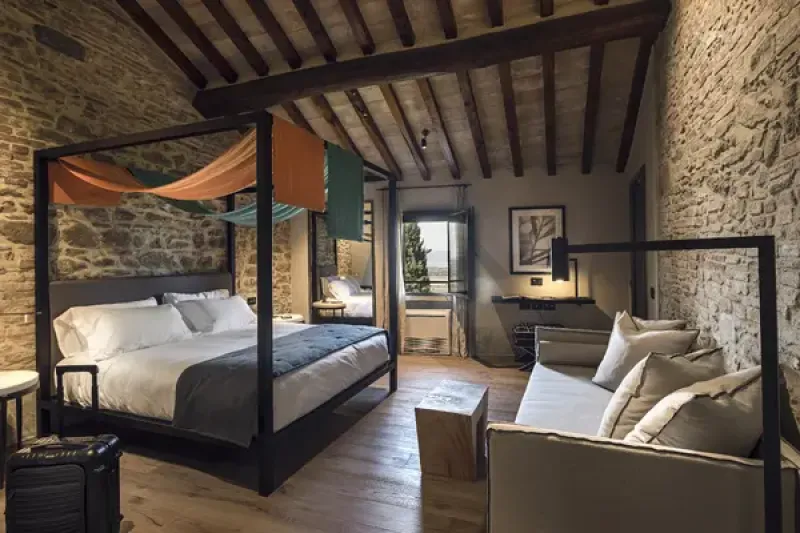
This delightful fully-restored 14th Century Palazzo hotel on the border of Umbria and Tuscany has recently achieved B Corp certification – and not many companies in the accommodation and hospitality sector have that credit to their name.
Family-owned and independently-run, the Design Hotels member has a picturesque location in the ancient medieval town of Panicale in Perugia. Its original stone walls, beams and iron work honour the timeless feel of the region – it was an abandoned house when Christiane Wassmann bought and lovely restored the building. Renovations were carried out using a third-generation local construction company, using traditional materials and methods.
There are just nine guest rooms, offering views of Lake Trasimeno. Guest slippers and staff uniforms are supplied by This Was a Sheet, which gives new life to hotel sheets and towels.
The majority of the produce used in farm-to-table restaurant Cucina and Giardino comes from the hotel’s own organic gardens, while grains, wines, cheeses, charcuterie, spirits and sodas are from local suppliers. Curated cocktails are whipped up with foraged herbs, flowers and nuts.
Surrounded by ancestral olive groves, more than 400 years old, the hotel also produces its own award-winning, premium extra virgin olive oil. Crops are harvested in the traditional way, no herbicides or pesticides are used, and bottles are made from 100% recycled glass.
rastrello.com
Hotel Why in Setouchi
Kamikatsu is the first ’zero-waste’ town in Japan, and Hotel Why is central to its efforts. The town serves as a living laboratory, inviting visitors to engage with its groundbreaking zero-waste initiatives, through immersive stays at Hotel Why, a property furnished with upcycled materials and scrap wood, and dining experiences at Pertornare, an Italian restaurant that uses locally sourced ingredients and supports the region’s agricultural heritage.
There are no convenience stores or supermarkets in the town – each store in the town sells goods for everyday needs by weight, eg at the general store you bring your own container for cereal or shampoo. When guests check into Hotel Why, they are provided with soap and drinks based on individual usage. For breakfast, guests make their own bagel sandwich with ingredients in a bento box, and there’s yoghurt with granola made from leftover coconuts used in the town’s craft beer brewery.
Hotel Why is connected to the Kamikatsu Zero Waste Centre, which has a recycling rate of 80% (100% is the aim). This is achieved by categorising waste in 43 types, ensuring maximum reuse. Guided tours are conducted in English, and visitors can take part in the waste sorting themselves.
setouchi.travel/en