





Launching a new website – or refreshing an existing one – can be a daunting task, and is often put on the perpetual backburner. But it can also be a wise investment to have a professional-looking digital shop window.
Greater volume and “quality” of enquiries, along with increased bookings, are some of the top-line outcomes reported by Kev Kneale (inset right), director of agency and operator Travel Bookers, which launched a completely new website in early September.
Paramount Cruises senior product manager Marco Macchieraldo, meanwhile, reports a 15% increase in organic search traffic since the agency’s newly built site from Swedish cruise technology specialist Dreamlake launched last May (citing that its previous technology was hindering its long-term growth).
And Daniel Hyman, co-founder of Blue Den Travel – which launched under the Advantage Managed Services set-up in May 2024 – reports a tripling in its website’s visitor-to-enquiry conversion rate since its relaunch in March.
Here are the three agents – plus Lear Travel founder Nadine Lear’s – seven top tips for making the launch of a new website as smooth as possible.
1 DECIDE WHETHER IT’S BOOKABLE
Whether to make your website bookable or not really depends on the nature of your business. “For smaller, relationship-focused agencies, I believe a non-bookable site allows for a more bespoke and engaging client journey,” says Lear, who chose to update and enhance her existing site. “I’ve never had a bookable website, and that’s a conscious decision. I get to know each of my clients individually and tailor their holidays based on those relationships. A bookable site would take away that personal connection.”
Hyman agrees. “Our view is that a one-page landing page whose content is engaging and laser-focused will generate a reason for a customer to make an enquiry that will convert far better.”
However, a bookable website was key for Kneale, who joined agents from various companies to create Travel Bookers. It uses its own Atol and bonding.
“We needed the site to be up to date, searchable and bookable, and give clients the option of searching through our promoted offers or live availability to enable them to tailor-make their own package with all major airlines and bed banks. Crucially, though, an agent can also take over the web process from them if needed, with visibility of what they’ve been looking at.”
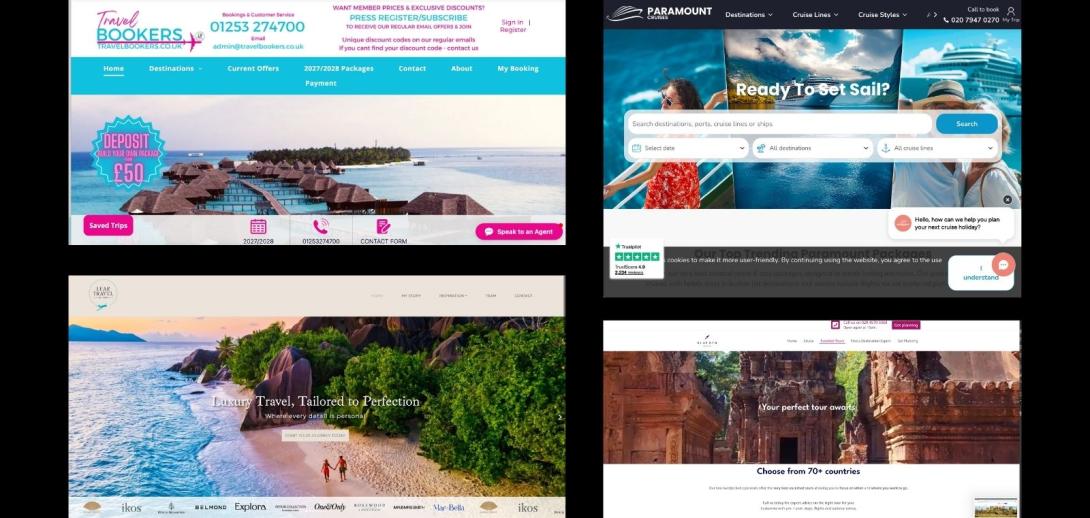
Refreshed websites, including (clockwise, from top left) TravelBookers.co.uk; Paramount Cruises; Blue Den Travel; and Lear Travel
Paramount Cruises created new “engaging and inspirational” content, including an increase in video – all compatible with mobile.
Macchieraldo says: “We wanted to offer a seamless online booking experience, while still providing exceptional service and expertise for clients who prefer to speak directly with our team.”
“This has allowed us to diversify our product offering and we have seen an increase in bookings for traditionally cruise-only operators such as Fred Olsen.”
Macchieraldo adds: “Online bookable websites are no longer the future; they are very much the present… we’ve seen bookings come through at midnight when it would just not be logical for a member of the team to facilitate that.”
2. DON’T LOSE THE HUMAN TOUCH
Despite this technology, Macchieraldo urges fellow agents not to “lose the human touch”. “Keep your sales team integrated with the online process. People often have one last question before committing to a purchase, or indeed post-booking.”
He adds: “If you’re using AI tools [for written content], ensure that you train it to use your tone of voice and writing style so that you have a consistent tone throughout your website.”
Lear agrees that those looking to launch a new site should consider how they want clients to feel when they land on it. “A good website should reflect your values, not just your services,” she warns. “It’s important to find a developer or designer who understands your business model and vision.”
3. THINK ABOUT BACK-OFFICE NEEDS AND GROWTH
The agents agree launching or relaunching a website is a great opportunity to make back-office processes simpler.
“When staff log in to our website, they have a full search tool for Jet2, Tui and other packages, and also build their own packages without the need to manually check various suppliers and bed banks. It allows the quote to be built, booked and loaded into the CRM all from one place,” says Kneale.
He adds the platform allows for unlimited users at no extra cost. Each staff member can share their own version of the website, and any bookings are automatically assigned to them. If an agent wants their own trading name, their logo can be displayed as a “branch of” or “in partnership with” Travel Bookers.
Macchieraldo agrees: “Having a website where you can easily update your content via a CMS is key as it allows you to react to changes quickly rather than needing to set up tickets and have a developer update code.” Similarly, a technical change to Blue Den Travel’s platform allows it to fully integrate with its tracking and CRM software so the business knows where customers originated from and can follow up.
4. SHOULD IT LINK TO SOCIAL MEDIA?
Lear says connecting her website to her Instagram page has been really valuable, as it ensures there’s always fresh content, travel inspiration and reviews, plus a visible link to her ongoing relationships within the travel industry.
Kneale adds: “If I see an offer on social media from an agent and go to the website, which is not searchable or bookable, I’m moving on. I don’t necessarily want to book online, but if I can go to an agent’s site and look at the options or search, I then know what to discuss with them.”
5. THINK MOBILE
Hyman recommends building new agency sites for mobile first, citing the high number of consumers who now browse travel on mobile. According to Statista, 68% of online traffic for travel and hospitality websites in 2023 was from mobile devices. “Be clear about the objective,” Hyman adds. “A one-page website with a ‘why you’ and enquiry form will convert far better than generic content.”
6. CONSIDER SEARCHABILITY
For those building an entirely new agency or brand, Hyman strongly urges choosing a name “that can be found”. “If you don’t appear at the top of Google, the name isn’t unique enough,” he says, advising choosing a name that is phonetic (without special characters) and has an obvious spelling.
“If [a bookable site] is not your business model, then consider affiliate links over bookable websites if you want to monetise your website,” he adds.
7. BEWARE HIDDEN COSTS
Kneale warns that the costs of building a new website can spiral. “Take the additional monthly costs into account when considering which developer to use,” he says, adding the company he used (Travelgenix), grants clients their own access for amends.