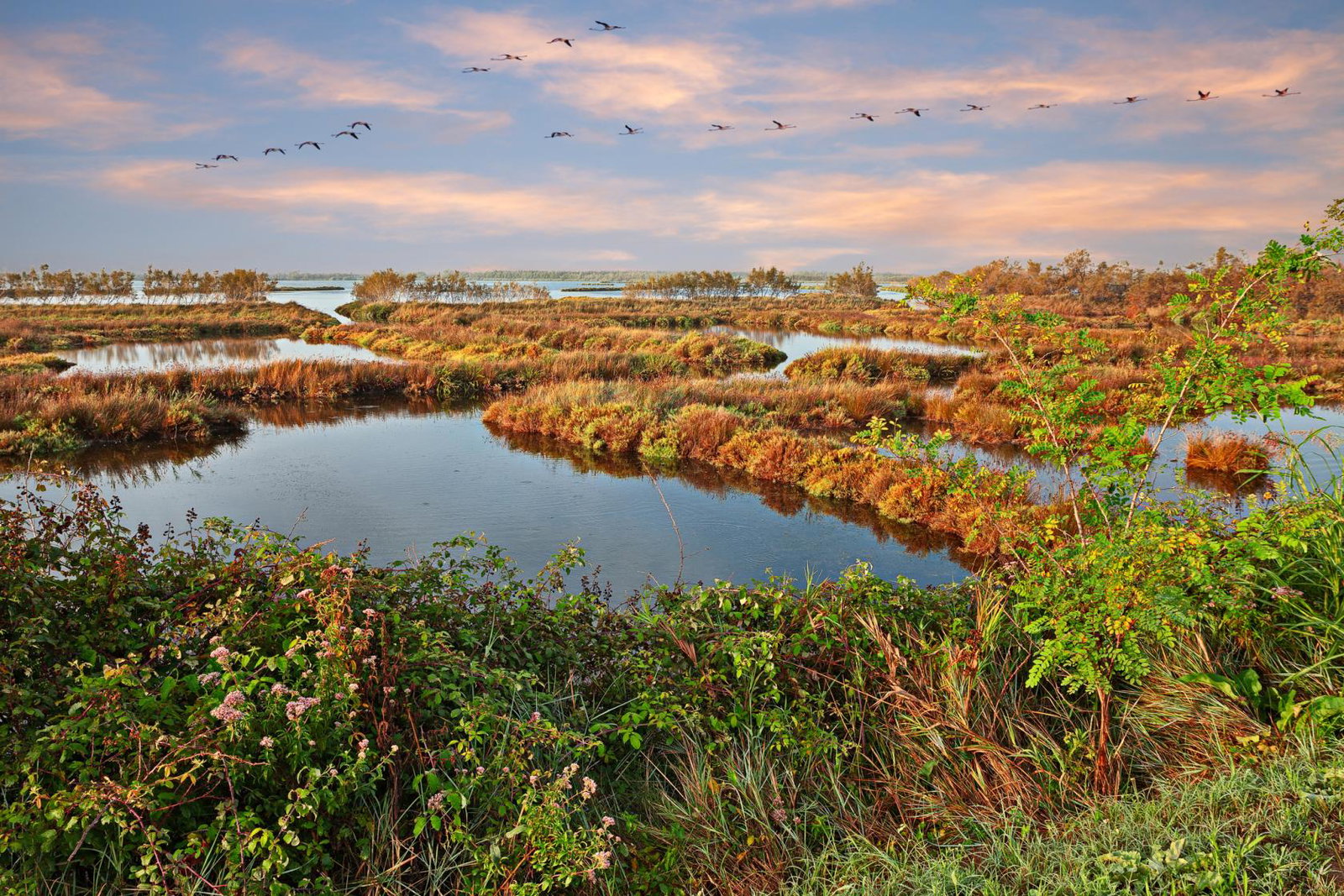
“If you see a very, very pink one, he’s a grandpa,” explained my guide. I was in Italy’s Po Delta, one of Europe’s most important wetlands and a haven for thousands of greater flamingos. With their flamboyant plumage, which gets progressively pinker over a lifetime of shellfish suppers, they’re easy to spot against the soft blues and greens of the delta.
Everyone loves a forest; in comparison, wetlands seem a hard sell to anyone who’s not a hardened birder. These marginal spaces – not quite land, not quite sea – are often overlooked, or drained to create ‘productive’ land.

However, some of the world’s best adventurous holiday destinations feature wetlands: Botswana’s Okavango Delta; Kakadu, Australia’s largest national park, with its thousands of crocodiles; the Brazilian Pantanal, which beats the Amazon for wildlife sightings.
This World Wetlands Day (2 February), I asked experts why wetlands need tourists, and what travellers gain from visiting these watery wonderlands…
Why should we care about wetlands?
“According to the 2025 Global Wetland Outlook report, across the globe, the services wetlands provide boost the economy by up to a staggering $39 trillion dollars every year,” says Clare Dinnis, director of wetland conservation at the Wildfowl and Wetlands Trust (WWT). The charity manages 10 UK sites, including the London Wetland Centre.
Wetlands provide a host of public goods. “Wetlands are flood-busting, carbon-storing, water-purifying, mood-boosting habitats that give shelter to 40% of the world’s wildlife,” explains Dinnis.
In a world where climate change presents an uncertain future, wetlands are becoming an ever more important key player.
“It’s absolutely crucial we conserve, protect and restore wetlands – because when wetlands thrive, wildlife and communities thrive too,” she says.
“Wetlands are like a kidney for the environment,” adds Andrei Prodan, a wildlife photographer who runs Bunica Maria, a guesthouse for birders on the Danube Delta. Europe’s largest wetland is also one of its least populated areas. “We are proud that we have one of the best-preserved deltas in the world.”
Across the world we’re losing wetlands three times faster than forests, and that’s a huge problem – but it’s one that tourism can help fix.
How can tourism help wetlands?
“When managed responsibly, tourism is one of the strongest allies in the protection of wetlands,” says Patrizia Guidi, president of Visit Comacchio, the destination management company which promotes the Po Delta.
“Tourism generates economic resources for conservation, supports local communities and strengthens environmental awareness,” explains Guidi. “The presence of tourists is not a threat, but a driver of protection and future development.”
How to sell wetlands
As activity breaks: There’s been a recent surge in interest in birdwatching among younger generations, but wetlands don’t just mean birdlife. They’re great destinations for kayakers, walkers and anyone interested in heritage, too, thanks to the communities who have historically depended on their resources. Offbeat activities might include full moon canoe tours, and electric bike tours – taking advantage of the flat landscapes. In destinations like Estonia, where some 7% of land is wetland, you can try bog-shoeing to get around (or stick to the boardwalks) on the trail of bear, moose and lynx.
As experiences: “We must tell their story as experiences, not just as places,” says Guidi. “In the Po Delta this means enhancing boat routes through reed beds, cycling itineraries along embankments, birdwatching in the Comacchio Lagoons, and gastronomy linked to lagoon products.” Wetlands mean an abundance of wild produce, like sustainably-caught seafood, and the salinity in wetlands like the beautiful Camargue in France imparts special flavour to produce, and makes this one of Europe’s oldest rice growing areas.
For health benefits: “Wetlands offer tourists a quiet moment away from the hubbub of everyday life, to reflect and relax by the water’s edge,” says Dinnis. You get fantastic, reflected sunsets, big skies, and long views. ‘Horizon gazing’ is the practice engaging your panoramic vision: proven to have a calming effect. Then there’s hydrophilia – our love of water, and the benefits of ‘blue space’ – research shows that being around water can have a positive impact on mood.
As liminal spaces: Travellers can lean into the liminal natures of wetlands. “Wetlands are places where nature, water and culture meet in a unique way… visitors enter a landscape suspended between land and sea,” says Guidi. Whilst some are vast mosaics of reeds and islands, others have beaches, too: you can combine Kerala’s backwaters with its beaches, and the Po Delta with nearby seaside resorts.
As year-round destinations: Spring and autumn mean migrant birds, but wetlands have life all year round. Some are salty and don’t freeze, creating winter waterfowl havens. “They change throughout the seasons, offering tourists the chance to see incredible wildlife spectacles 365 days a year,” says Dinnis. The WWT runs activities at its sites year-round – including, in February, a celebration of all things muddy.
Peaceful, or humming with birdlife, I’ve found that wetlands make me feel like I’ve wandered to the very edge of the map, even if I’ve only popped down the road – isn’t it time we celebrated these special places?
Eloise Barker is a writer at Responsible Travel