Learn more about the TTG Sustainable Travel Heroes programme
With increasing interest in experiences such as rail travel, wildlife watching, community-led experiences, slow travel and more, sustainable travel is a sector that not only benefits people and the planet, but also provides an opportunity for travel agents to experience real growth. Yet sometimes, communicating sustainable travel can feel like a daunting or difficult task. With the right information and tools, it doesn't have to be.
In the final TTG Sustainable Travel Heroes workshop for 2026, hosted by Lemongrass Marketing’s Alex Liste and Tara Schwek, the session taught agents how to spread the word about sustainable travel experiences in a way that’s meaningful, credible, inspiring and ultimately useful for the client, ensuring agents are scoring top marks for both customer satisfaction as well as sales.
Read on to learn some of the key takeaways from the session – so you can start selling sustainable travel with confidence too.
Why does communication matter?
It’s great when suppliers publish sustainability reports, certifications and policies supporting their sustainable travel initiatives – but simply sharing these with your clients won’t mean much to them. They need a translater.
“Agents can be that middle ground, turning lots of information into tangible trust points,” says Liste. “By translating complex supplier information into credible customer-friendly advice, this can help influence their decision.”
Liste also reassures agents it's not about becoming a sustainability expert overnight. “It’s about asking the right questions and helping [customers] by communicating honestly, giving them clarity so they can make their choice with confidence rather than confusion."
Experience first, evidence second
Liste explains selling sustainable travel doesn’t work if you lead with a lecture. “No one wants to be told off when booking a holiday.”
Instead, she suggests reframing how you sell sustainability, leading with the “desired experience” – the adventure, the comfort, the discovery – before backing it up with the evidence.
“The reframe is simple: the customer wants something meaningful, unhurried, well chosen,” she says. “The sustainability stories then build on that – providing proof of what you're promising them – instead of being the pitch itself.”
She adds: “This approach helps build confidence for agents, trust for clients, and also avoids jargon and greenwashing.”
Every channel has a role
Liste explains communicating sustainable travel can be most credible when focussing on a simple three pillar strategy – 1.) customer benefit 2.) proof point and 3.) next step. This method can be used across multiple communication channels, including socials, websites, email and in-store and events.
Liste explains every different channel has a role. “It’s about matching your message to the moment.”
For example, she says a great way to push sustainable travel on social media is to spark interest with human stories. "The content that we notice performs best is when you've got insight into people, for example, sharing local voices, such as guides."
Whereas pre- and post- booking emails can be a great way to send customers helpful, destination-specific advice on packing, transport, local etiquette, wildlife welfare tips and so on.
From claim to credible
The evidence you’re sharing with your clients has to come from somewhere – and that’s almost always the supplier. Before communicating any supplier claim to your clients, Liste says agents should ensure they are “accurate, evidenced and credible”. A simple way agents can ensure this is by getting the answers to the below questions.
- What exactly can you say?
- What proof supports it?
- What is the scope?
- What is still in progress? What assets exist?
Liste says: “By being able to answer these questions, you should be able to feel a lot more confident in discussing these experiences.”
When 'green' becomes a grey area
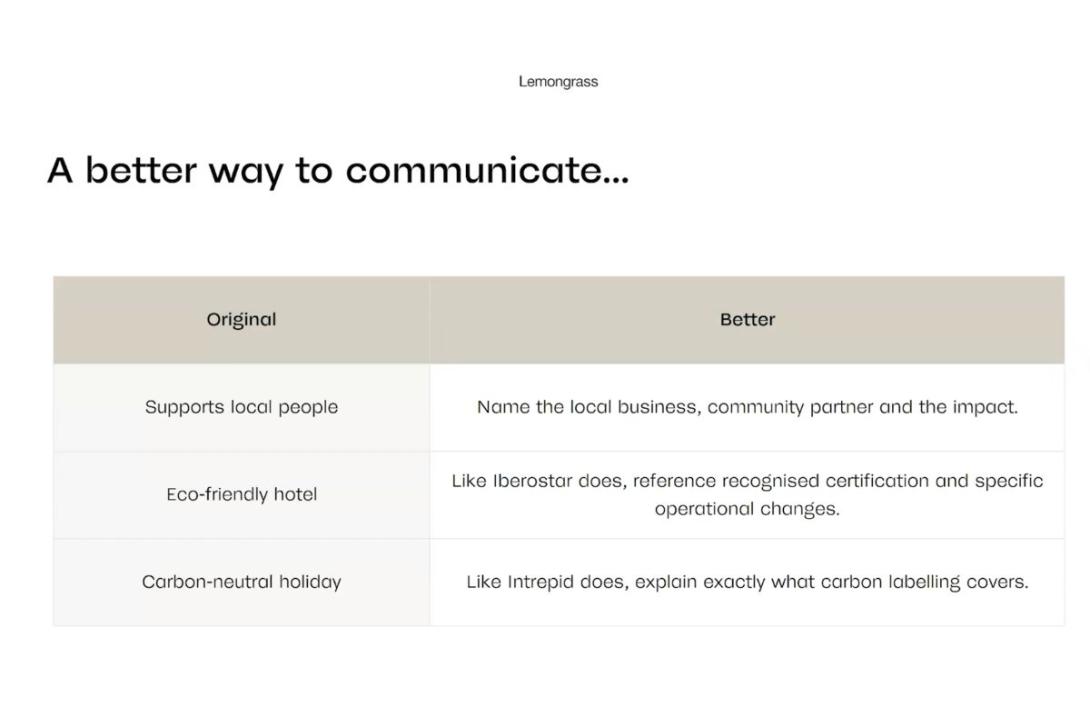
“Greenwashing can get you completely by accident,” says Schwek, who highlights how this can happen through vague claims, unclear scopes and overpromises.
For example, she says how claims such as ‘committed to sustainability’, ‘eco-conscious’ and ‘green’ are often used as they seem safe, but they're actually risky as they don't really say anything.
Another example is how beautiful imagery can often replace evidence – for example, turquoise waters or rainforest canopies . “These can imply environmental credentials never said out loud – and it works, as no one has to prove it.”
Agents are encouraged to ask for further evidence from suppliers if they’re unsure. “[Suppliers] should be delighted to share their proof – if they get defensive, this usually tells you everything you need to know.”
Schwek also highlights how sometimes 'greenhushing' comes into play – when suppliers are not shouting enough about their sustainability work enough.
“Nobody is perfect – but customers appreciate honesty and like to know what has been achieved.” She says. “A claim with a caveat is so much more trustworthy than a claim without one.”
Resources for agents
The Lemongrass Marketing team also shared the below resources that might come in useful for agents when it comes to greenwashing.
• The Government’s Green Claims Code Checklist – this sets out six key points to check your environmental claims are genuinely green and comply with consumer protection law.
• WWF Guide to Greenwashing – a resource that can help when reviewing suppliers’ eco claims.
• Advertising Standards Authority’s Copy Advice – discover how businesses can get a free review of advertisements to ensure they adhere to the body’s rules.
Learn more about the TTG Sustainable Travel Heroes programme