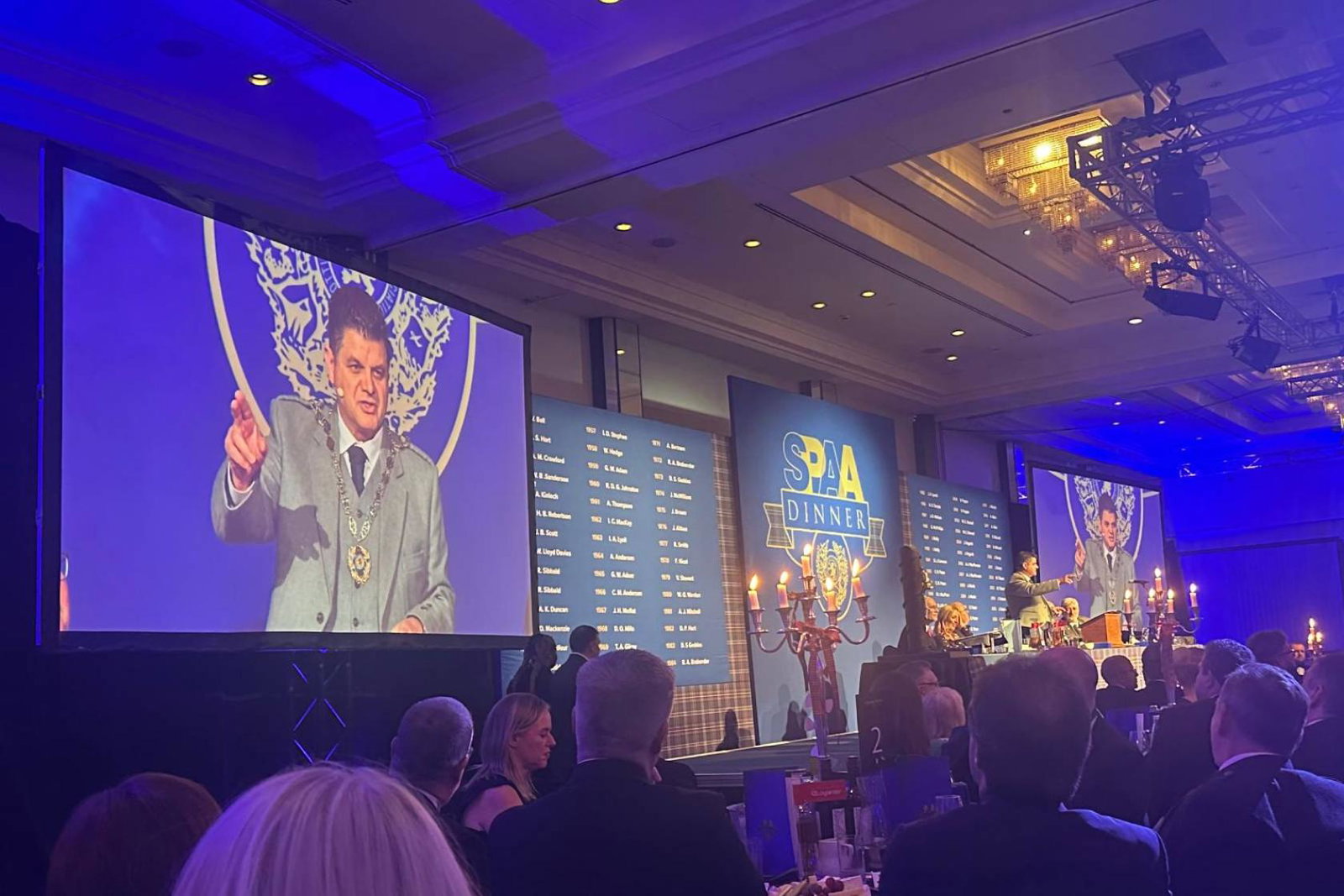
In a wide-ranging address at the association's annual dinner on Thursday (26 February), Alan Glen touched on the rising cost of doing business in Scotland; the impact of new fees and charges on travel and tourism; the rise of AI and a new "Wild West" and, ultimately, why agents are uniquely placed to navigate all of these challenges.
Turning first to economic matters, Glen branded employers' National Insurance a "stealth tax" adding around 13% to the cost of employment which, in many cases, is exceeding businesses' corporation tax bills.

Glen said the arrangements risked discouraging recruitment. "Employer’s National Insurance comes straight off your bottom line, and then you’re taxed at 25% on whatever profit you have left," he said. "I call that a tax on employment investment."
He questioned how agencies are expected to recruit new entrants while employment costs, including wages, continue to rise and amid a lack of funded apprenticeship schemes in Scotland. "There's no incentive for companies to bring new people into the travel industry," he added.
Glen also cited business rates revaluations and high utility costs as additional pressures on high street agencies, arguing the cumulative impact is making it increasingly difficult for firms to compete.
Scottish tourism 'disadvantaged'
Turning to taxation, Glen criticised what he sees as an uneven playing field between UK-based firms and multi-national corporations, claiming domestic businesses are an "easier target" for government revenue-raising.
He also raised concerns over further direct taxes on travel and tourism in Scotland. The Scottish government is set to replace Air Passenger Duty with a new Air Departure Tax from April 2027, while local authorities are exploring options for visitor levies (local tourism taxes). New charges that could be levied on the cruise sector are also being discussed.
"If tourism is such a big driver of the economy in Scotland, why disadvantage the people in aviation and hospitality industries that already struggle to make ends meet?" Glen continued, warning higher costs would ultimately be passed on to consumers.
Glen argued that in a global marketplace, Scotland risks pricing itself out of people's travel plans. "Flight routes depend not only on inbound travel, but outbound travel too," he stressed, adding hotels and self-catering operators would have little choice but to increase rates if new levies are introduced.
He also criticised recent guidance from the Competition and Markets Authority (CMA) requiring greater transparency on how any mandatory fees or charges, like room or city levies, are presented to consumers up front, such as in advertising or at point of purchase.
While stressing he supports transparency, Glen said agents are now effectively responsible for tracking and disclosing multiple overseas taxes and charges they neither set nor collect. "It’s opening a Pandora’s box for people to complain if you haven’t got it quite right," he said, highlighting complex multi-centre itineraries and cruises as being particularly fraught.
Is anybody going to regulate AI?
Glen touched on AI in his address after attending an AI and travel technology workshop at the Edinburgh Futures Institute, likening the new technology and its development to "the early days of the internet".
"The good news is nobody really knows what it will look like," he said. "The bad news is whatever is going to happen will probably happen a lot quicker than we think."
Glen added agents who embrace AI are likely to fare better, drawing parallels with those who adopted online tools early in the internet era. However, he warned of growing concerns around regulation and data authenticity, questioning how governments can effectively oversee rapidly evolving AI systems.
"There’s so much fake data being generated – it’s getting harder and harder to determine what’s real," he said. "Who, if anybody, is going to regulate AI? Is it even something that can be regulated now the genie is out of the bottle?"
‘We're a safe pair of hands'
Despite the challenges, Glen ultimately struck an optimistic tone, positioning agents as a trusted, "verifiable" presence in what he described as a new technological "Wild West". "We’re dependable. We are a safe pair of hands," he said. "No one knows where we’re headed, so buckle up and enjoy the ride".
He concluded by urging agents to lean into change rather than resist it. "The reason we are all still here is that we are adaptable," he said.