We place our food as an offering before the Buddha and kneel, hands raised in prayer. The wind carries the young monk’s chants through the forest, and we try to recite the Five Precepts, known as Pañca Sīla, as instructed. As the only tourists here, we couldn’t feel more distanced from Western life.
Inside the simple monastery building, an elderly local lady sits on the floor preparing betel leaves and areca nuts for the monks. We are ushered into a bare room where four monks are seated at a long table. Our host explains how to serve the monks' food, and using coconut-shell spoons, we do so guided only by their silent hand gestures.

Donating food to the monastery is an ancient and sacred practice known as Almsgiving. Almsgiving is an integral part of Buddhist philosophy; it is considered a way for laypeople in the community to support the monastery and gain spiritual merit or positive karma.
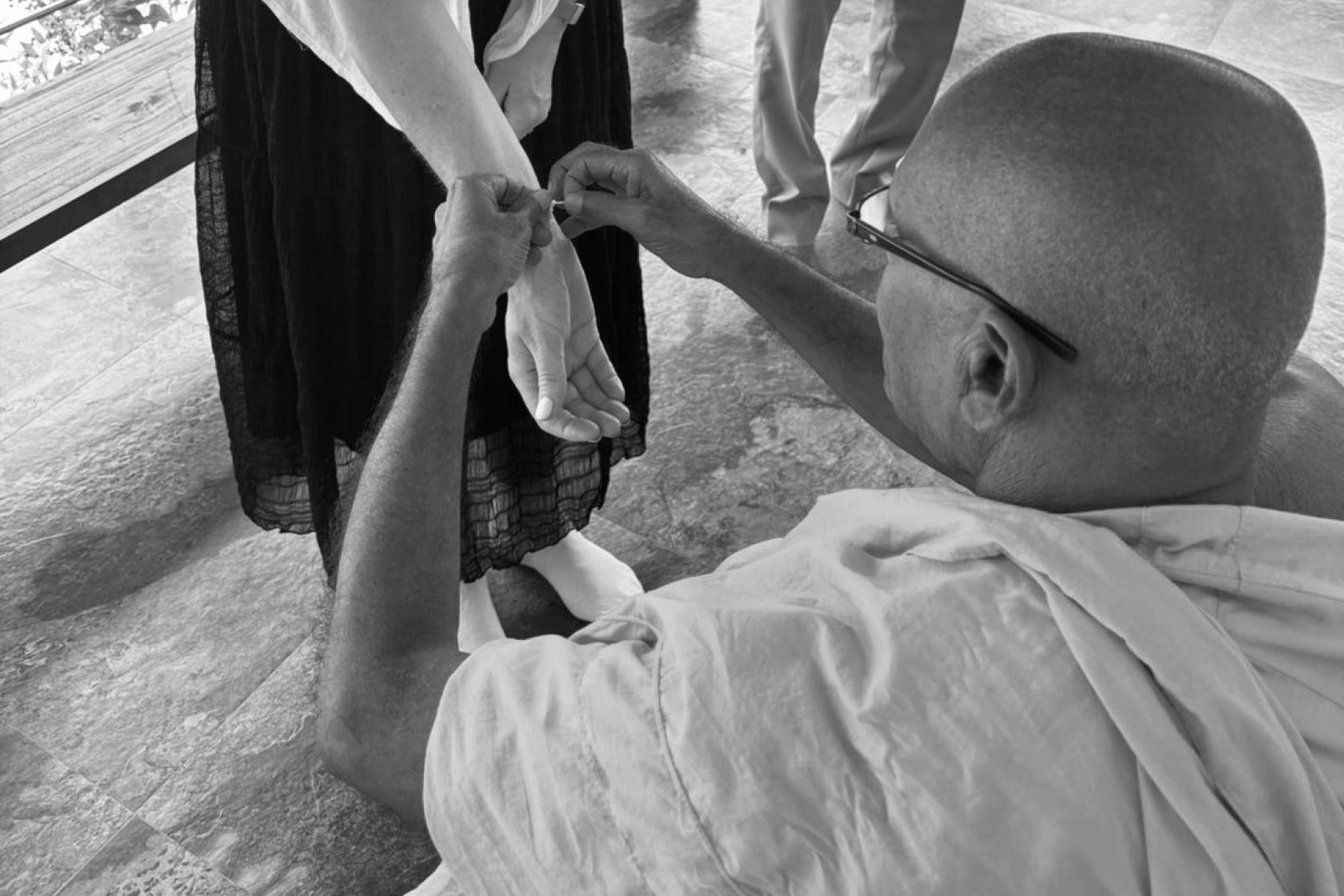
After the monks eat, the priest ties a protective white thread around our wrists, chanting a blessing. The scene is meditative and calm. Outside, villagers explain their rota for preparing meals for the monks, who eat two meals a day and rely on community support.
This peaceful experience not only grounds us in the sacred heart of Sri Lankan culture and heritage but also sets the tone for the rest of our journey around the island.
Building on this insight, we see how Sri Lanka’s landscape – ruined ancient cities, Buddhist temples steeped in history, 1,340km of coastline, designer hotels, world-class wildlife, exquisite cuisine, and breathtaking scenery – draws tourists from around the world.
Over the last two decades, Sri Lanka has endured a series of hardships since the end of its bloody civil war. The country has faced the 2004 tsunami; the Easter bombings in 2019; Covid-19; economic collapse in 2022; and just recently, a devastating cyclone. Despite overcoming myriad challenges, the average rural Sri Lankan remains impoverished, getting by on a very low income.
Uplifting communities
However, a new breed of tourism operators is offering hope against this backdrop. We are travelling with Renew By Authenticities, a DMC which is striving to create a model of positive impact tourism. Madara Kulatunga, head of impact travel at Renew, explains to me: “We are designing itineraries which focus on uplifting communities, biodiversity, and the environment. We have developed a holistic carbon framework which measures energy consumption and other elements such as community engagement, philanthropy, and conservation.”
With Renew, itineraries shift from ticking off the island’s most popular sights to deeper cultural and environmental immersion. We engage with the rich cultural, spiritual, and community life of Sri Lankan people, gaining a deeper understanding of their religions, philosophies, and history.
The following day, our adventure continues as we venture into Kaudulla National Park, where macaque monkeys swing from the trees and the humid air is thick with bird calls. Our jeep emerges from the tropical forest into a vast clearing filled with wetlands and the sparkling Kaudulla reservoir, backed by jungled mountains. We spot a fish eagle in a tree and kingfishers flying low, looking for their next meal.
A single elephant lumbers out of the forest, and we watch transfixed as he walks, flapping his ears, across the wetlands. Moments later, in the distance, we spot a group of around 30 elephants, including their young.
As we ogle this truly beautiful sight from afar through binoculars, jeeps begin to arrive from all directions, and soon there are about 20 jeeps queued up near the group of elephants. The elephants become visibly upset by the noise; unfortunately, the jeeps are far too close to these majestic wild creatures.
It’s the incredible biodiversity of Sri Lanka’s game parks that attracts perhaps the most significant of this growing overtourism burden. Minneriya, Kaudulla, and Eco national parks are all connected and form part of a 66 square kilometre ‘elephant corridor’, which means that every July, they are home to one of Asia's greatest wildlife spectacles as hundreds of elephants gather. Yala National Park, located in the south, covers 980 square kilometres and is home to an impressive density of wildlife, including elephants, leopards, crocodiles, water buffalo, monkeys, deer, and one of the island's great diversities of bird life.
However, in the peak season last year, 850 jeeps were recorded on one day in the popular ‘block 1’ zone of the park.
These scenes reinforce the consequences of unchecked tourism: overcrowded heritage sites may lose authenticity, wildlife corridors suffer, and local communities are often left behind.
But it doesn’t have to be this way. There is a more sustainable and inclusive model, being pioneered by a new generation of Sri Lankan tourism operators.
Shoulder season benefits
We are travelling in October, which is considered the shoulder season in Sri Lanka, yet we've hardly seen any rain, and nothing has impacted our plans. Instead, we are often the only guests in the small boutique hotels we stay in, we get to know the staff and are welcomed as if we were family. All our accommodations have sustainability at their heart: intentionally designed to minimize environmental impact, built with local materials, employing local staff, and serving only locally produced food.
Many of the hotels, lodges, and camps go further than that, contributing to the local community by way of education projects, conservation efforts, recruiting and training vulnerable youths, focusing on recruiting women into tourism (still a rarity in Sri Lanka), and offering ways for the local community to benefit from the presence of tourism. They don’t do this to gain a “green tick” as many accommodations do; they do it because they feel a sense of responsibility, as a natural consequence of their existence.
A great example of that is Kulu Safaris, located near Yala National Park, which is a well-located camp for accessing the lesser-visited ‘blocks’ of Yala. They are well known for recruiting vulnerable young men into their training programme: Malshia is a 19-year-old young man who just two short years ago was struggling with drug and alcohol addiction, but we now witness him running the staff kitchen at Kulu with ease and efficiency.
By recommending to our clients that they stay in family-run guesthouses, savour local cuisine, and engage with Sri Lankan-run operators committed to preserving their pristine environment, we can help accelerate recovery and support a more sustainable future for an island teeming with life, history, landscapes, wildlife, and culture.