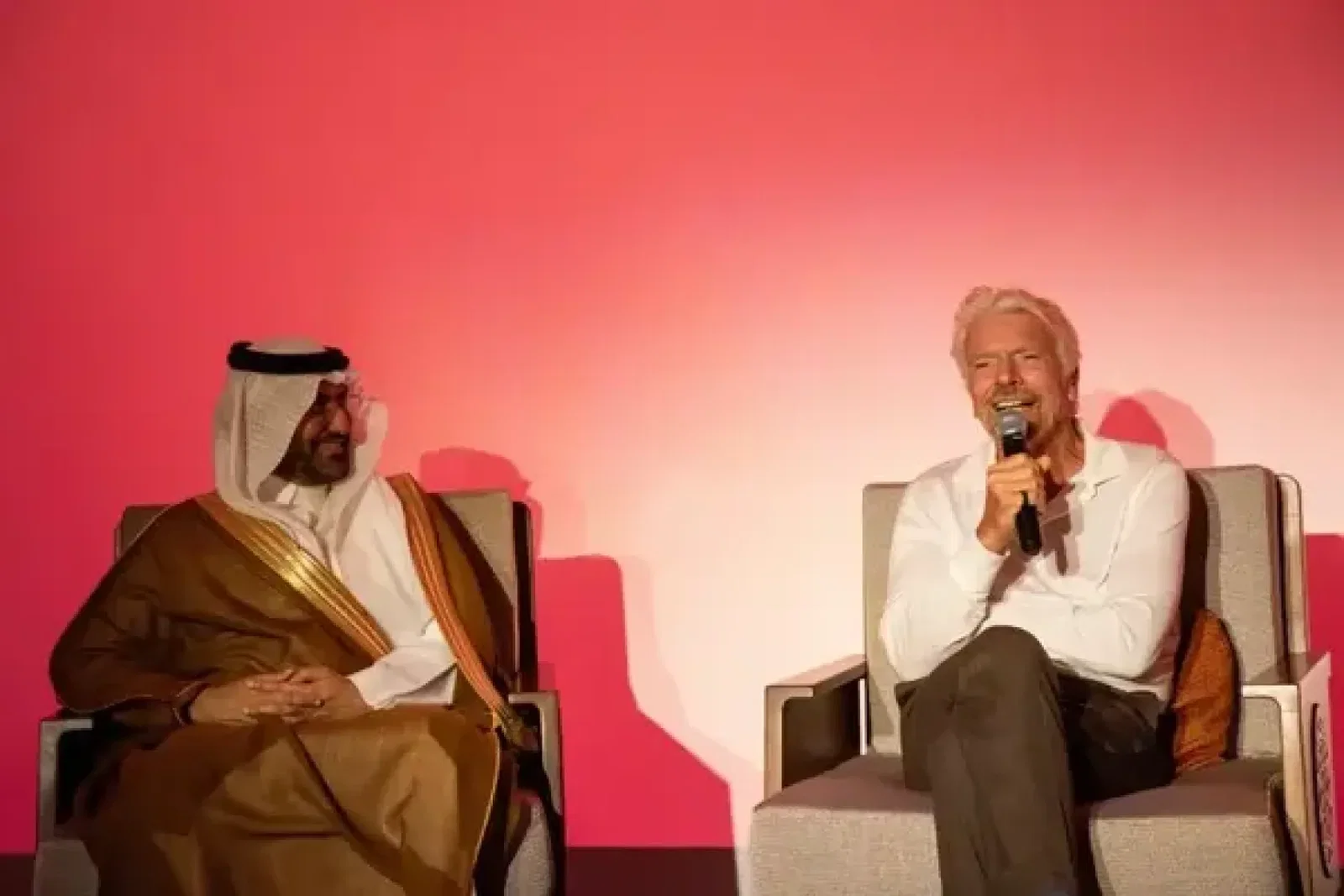
It seems an odd choice of destination for someone who used to own Heaven – one of London’s premier gay nightclubs – and who has been outspoken on human rights issues, but Sir Richard Branson and the Virgin Atlantic caravan has now arrived in the desert – or at least, Saudi Arabia’s capital Riyadh.
Speaking to TTG as Virgin celebrated the Heathrow inaugural last month, Branson explained his rationale for the route’s launch and how he tries to use his influence at the highest level to effect change in a country where homosexuality could be punishable by death and women have fewer, although growing, rights.

Saudi Arabia’s image fell to one of its lowest points in 2018 with the murder of journalist Jamal Khashoggi, a critic of the country’s leaders. His death is widely believed to have been sanctioned by the country’s prime minister, crown prince Mohammed bin Salman, known as MBS, who denies ordering it but has accepted responsibility.
Branson was very vocal about this at the time, so what persuaded him Riyadh was now an appropriate place to launch flights?
“I think the Saudis have changed dramatically over the past six to seven years,” he said. “I made a point, even after that incredibly unpleasant incident, of keeping in touch [with MBS]. I think I have made my position clear on that one. I think a lesson has been learnt.
"In the last seven years, they have made a lot of changes internally. They don’t do everything as happens in Britain – but if you go to America, some of the southern states are executing more people today than they have done before.”
When it comes to soft diplomacy, Branson is perhaps the travel industry’s most powerful figure, and reveals he has a regular dialogue with MBS. The latter has the challenge of appeasing his young population – 70% are under 30 – and the old guard of Saudi’s royal family. He has given small concessions, but maintained a hard line – allowing women to drive, for example, while also imprisoning some who campaigned for it.
Similarly, the quest to open up the country by building tourist resorts has seen people forcibly displaced from their traditional lands, with at least one reported killing of protestors, according to the BBC.
All this, though, has seemingly been pushed aside by the sport and entertainment events MBS has attracted using the country’s vast oil wealth. So, should Virgin Atlantic be there?
‘Balancing act’
Branson believes MBS, at 39, is keen to liberalise, but knows he must keep traditionalists happy. “I have kept in touch with MBS,” says Branson. “I have had one-to-one dinners with him. I believe he would like to do all that [liberalise], but he is not the king and there is a very, very strong religious group of powerful people he can only push so far – and will keep pushing – but he has got a balancing act.”
Branson thinks the country will become more liberal. “Step by step, I would say Saudi Arabia will go closer to Dubai over the next 20 years as long as there is not complete upheaval. I think he [MBS] would like to move in that direction and has the resources to do it."
He mentions the 35% female workforce, pointing out: “No women were working six to seven years ago.” This was later reinforced by a Saudi airline executive, who proudly told me at a party hosted by Virgin Atlantic that his entire intake of engineering apprentices was female.
Virgin Atlantic is not expecting a backlash from the LGBT community because of the new flight. “They are not unlike a lot of countries where there are plenty of gay people, gay princes, in Saudi Arabia, but they don’t have a Heaven nightclub," said Branson.
"I have a lot of gay Saudi friends who don’t feel uncomfortable living in Saudi. They’re not rounding them up on the streets – people can be themselves.” Highlighting the progress he has witnessed, he added: “When I was last there [in Saudi Arabia], every single woman had a covered face. That is no longer the case.”
Branson left the celebrations for the inaugural flight to fly to the coastal city of Damman, and a midnight meeting with MBS. Branson later stressed he did not discuss gay rights with the crown prince, but added: “Next time I shall bring it up.”
He disclosed: “We discussed plans for Virgin in Saudi; there are some things we are definitely going to pursue.” These, he confirmed, include opportunities for Virgin Hotels. “Hopefully we will be setting up [flights to] Jeddah one day," he continued, adding there “may be” a Virgin Voyages cruise call to come, describing the Red Sea islands as “exquisite and completely untouched”.
Tourism quest
But should Virgin have waited a few more years? Branson doesn’t think so. “By trading with countries and interacting, we are more likely to see change than if we didn’t. Having waited seven years, I think we’ve waited long enough."
By launching flights to Riyadh from London, Virgin is hoping to tap into a home market of some 38 million Saudis. At the moment, 80% of sales are Saudi in origin, and 20% from the UK.
The country, though, is desperate to encourage tourism, and that mix could yet even out. Virtually closed to outsiders until 2019, there is a target within Saudi Arabia’s Vision 2030 masterplan – aimed at reducing its dependency on oil revenue – to attract 150 million annual visitors.
TTG was part of a trade and media delegation accompanying Branson to Riyadh. Journalists were warned by Virgin Atlantic about questions on human rights, and were reminded any criticism of the Saudi government, the country’s culture or royal family, is illegal. While we never felt ill at ease, questions steered clear of controversy.
We spent two days in Riyadh, the population of which – according to my excellent guide – has jumped from seven million in 2021 to nine million owing to Vision 2030.
Although much of the tourism development centres on the Red Sea and the desert, scores of cranes dot the horizon in Riyadh, including the area in which we stay, Diriyah, 25km from the centre. Branson tells of a breakfast meeting where he counted 84 in one area alone, with 42 hotels under construction.
At 40 square kilometres, Diriyah, known as the country’s birthplace, will be the world’s largest mud city, built around a Unesco World Heritage site. With most of Riyadh architecturally unspectacular and heavy with traffic, it’s easy to see why Saudis want to go back to their roots.
By contrast, Diriyah is a tranquil haven that comes to life at night. At 1am on a Saturday, its cafes and restaurants are buzzing with locals who have really taken to it. It would be unkind to characterise Diriyah as a bit of a theme park. It’s genuinely pleasant, and the work on the original Unesco site is to be applauded.
More than 30 hotels are planned here. Mine, the Marriott Bonvoy, is modelled on the old city and is quite the luxury hideaway. Mega-projects like these surround Riyadh, with hoardings seemingly on every major roadside.
‘A new beginning’?
At a muted press conference, Fahd Hamidaddin, chief executive of the Saudi Tourism Authority, described Virgin’s arrival in Saudi as part of "a new beginning”. Hamidaddin admitted the country had been seen as “not as friendly for families and women”, and claimed: “Today, that is history – we have turned a page.”
Tourism is a key part of Vision 2030, Hamidaddin said. With an astonishing $800 billion to invest in developing some 1,800km of Red Sea coast and hundreds of islands, plus 12 Unesco sites, including ancient monuments to rival Petra, it can’t be allowed to fail.
Then there is sport. Saudi Arabia has been confirmed as the host of the 2034 Fifa men’s World Cup, and the country has just hosted its fifth Formula One grand prix. “Last winter in Riyadh, there were more events than in Las Vegas,” said Hamidaddin. Perhaps the only sport to openly refuse Saudi money is darts, with the alcohol ban said to be a deal-breaker.