A few years ago while screening my film ‘Dusk’ across US film festivals, I landed in a little town called Bloomington, Indiana. After long weeks of networking and unfamiliar faces, this artsy, student-populated queer haven, with rainbows on crosswalks, bars and parks, felt safe, welcoming and familiar. I had a fantastic few days there and can only hope that it survived the last few turbulent years in the US’ rapidly evolving political climate, a climate that now serves as a powerful deterrent to large swathes of LGBTQ travellers.
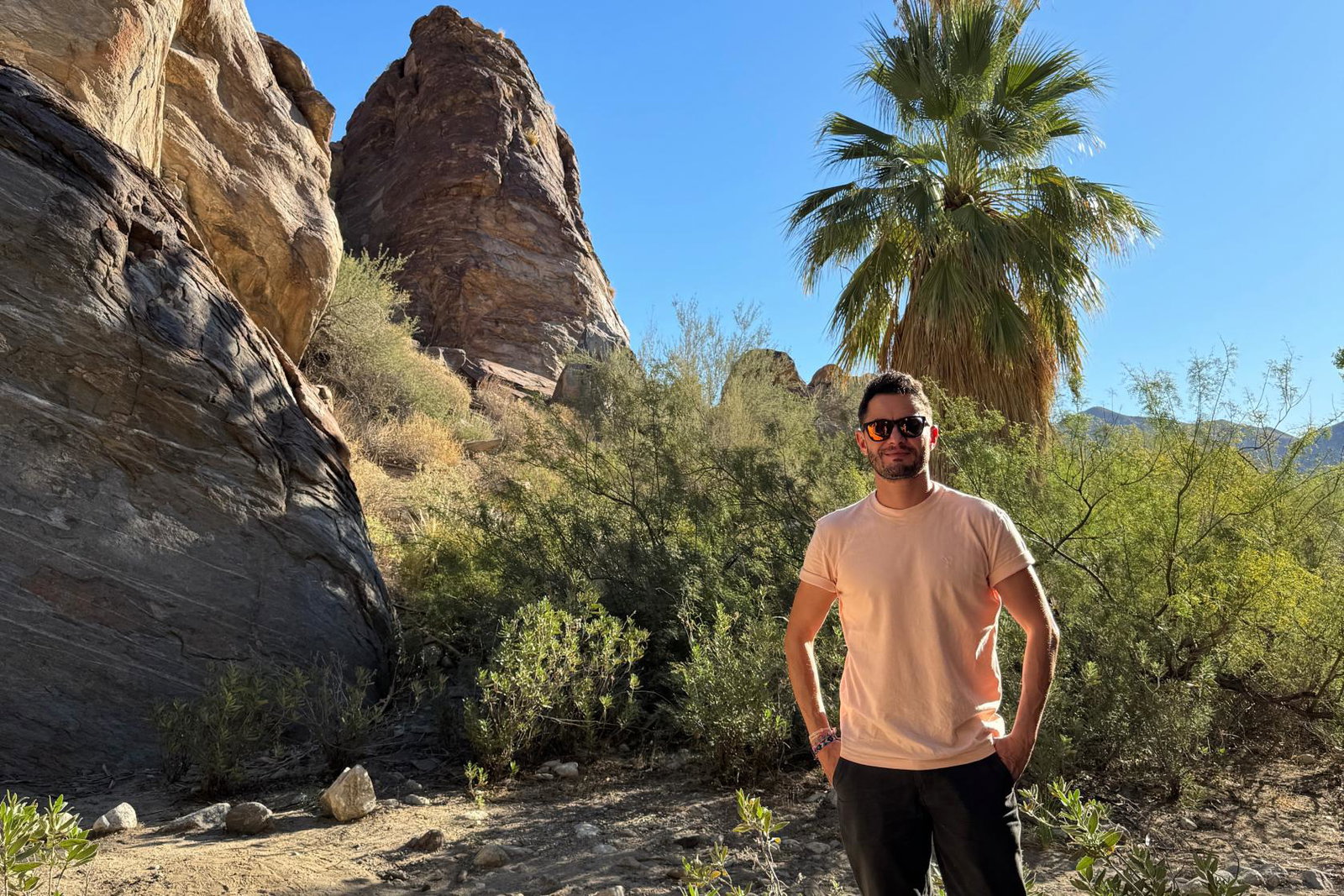
Last January, I, too, sadly resigned myself to forgoing US travel until the waters calmed, until an unexpected invitation to visit the legendary Palm Springs desert, a bucket list destination of mine. It sounded almost too good to be true: a warm, vibrant desert oasis, unashamedly and defiantly queer, welcoming to all. I needed to see it for myself, and after some rather meticulous planning to avoid landing in a red state, headed off to find sanctuary.
The travel guides describe the city as ‘a glamorous, sunny getaway with a relaxed pace, famous for pools, cocktails, and starry nights’, but for the LGBTQ traveller the city’s embrace is quite surreal. As surrounding states see rainbow flags removed or banned, here they have become symbols of joyful defiance, of a refusal to yield to the bullies.
For many queer travellers, anxiety begins upon landing: customs, security, bag checks, the potentially uninformed airport driver and awkward hotel check-in. Here, even the airport is adorned with the universal rainbow welcome of the LGBTQ+ community. Mainstream travellers may not appreciate the powerful mental shift we experience when the acceptance is so visible, but we certainly feel it.
My chatty, laid back driver made the stunning 15-minute cruise through the valley a pleasure. I was driven to the Trixie Motel, the bubble-gum pink paradise in the Old Las Palmas neighborhood. Owned by drag superstar Trixie Mattel, this isn’t just a hotel; it is a queer landmark. During my five-night stay, every staff member I encountered was LGBTQ identified. On my first morning by the pool, I met a trans couple on their honeymoon. For travellers seeking absolute psychological safety, places like the Trixie Motel offer more than luxury; they offer the exhale of being completely understood.
The magic of Palm Springs is that the ‘welcome’ isn't confined to a few blocks of nightlife. It is woven into the city's commercial and civic DNA. If a business isn't queer-owned, it often displays signs explicitly stating their support. From sublime restaurant Alice B., owned by celebrity lesbian chef Susan Feniger, to the cheery and modern Living Out senior apartment community and the happily chaotic Drag & Fly Tours, a ‘drag cabaret on wheels’, the queerness is ingrained, not as a marketing gimmick, but as a lived reality.
The importance of these hubs cannot be underestimated, offering sanctuary to more than just tourists. I met Jaden, a gay twenty-something from neighbouring La Quinta, who moved to the valley as soon as he was able, fleeing an abusive home. And Cathy, a twinkly-eyed waitress at my local diner, who came out late in life, started afresh in Palm Springs and found love in the desert. The US’ queer safe spaces are more important than ever as rights and protections are rolled back nationwide.
Of course, Palm Springs has so much more to offer than simply its ‘haven’ status. There’s the historic Aerial Tramway that glides you up the San Jacinto Mountain, offering stunning views of the valley, and the iconic Palm Springs Art Museum featuring modern, contemporary, Native American and Western American art. You shouldn’t miss the Agua Caliente Spa at Sec-he, voted top spa in the US in 2024 and a highlight of my visit. Then of course there are the miles of sprawling desert, and the nearby Joshua Tree National Park, silent, otherworldly and truly vast.
As LGBTQ travellers, we have a responsibility. It is easy to judge from afar and feel justified in boycotting a country, but in doing so we inadvertently punish the very sanctuaries that are fighting to keep our wider community safe. These enclaves depend on tourism. They depend on the ‘pink dollar’ to maintain their infrastructure of safety and shouldn’t suffer due to any overarching politics.
These pockets of acceptance – Northalsted in Chicago, the first official gay neighborhood in the US, San Francisco, New York, Los Angeles, Austin, Seattle and Portland, and smaller havens like Bloomington, Indiana and Palm Springs – are vibrant, essential, and need our support. Let’s not turn our backs, let’s join their revolution. Because these havens will still be there, fighting the good fight, when the political tides eventually turn.