It’s been mere moments since I stepped into the taxi taking me from Indira Gandhi International Airport to my hotel.
Already, most of my senses are being bombarded; first, with the humidity that slaps me moistly around the face as I emerge outside, then by the cacophony of honking that doesn’t let up until I enter the cocooning calm of the five-star Leela Palace.
It transpires that using your horn is a way of life here, with urgent beeping used to signal lane changing, assert right of way, and, of course, to express impatience with the regular gridlocks.

During the half-hour journey, I’m also transfixed by the sight of the occasional cow wandering nonchalantly alongside the traffic; they’re revered as sacred in India, and allowed to roam freely.
There’s also time to marvel at the colourful murals painted on the walls which line most major roads and decorate the underpasses. By the time I clamber out of the car and find myself welcomed with a glass of pomegranate juice and a flower garland, I feel like I’ve been officially introduced to Delhi.
At first, Delhi might sound daunting to clients who’ve never visited India before.
Sprawling over 573 square miles, it’s home to around 34 million people, making it the biggest city in the country by size, as well as population.
And yes, some of the clichés are true: street food sellers loudly hawk their wares, as women stroll elegantly in bright saris.
Beggars beseech passers-by for rupees, while stray dogs lie languidly in the shade – all the kind of images that clients might well have seen recently in the latest series of BBC 1’s epic reality show, Race Across the World, which this season focuses on India and China.
But Delhi is so much more than that, packed full of treasures which combine a mixture from both the British and ancient Mughal empires.
I book a half-day city tour through the Leela Palace’s concierge desk, and my guide, Vasu, explains the difference between ‘Old’ and ‘New’ Delhi as we navigate the wide, leafy streets in air-conditioned comfort.
The sight of so much greenery – the tree-lined avenues, verdant parks and gardens – surprises me, but in fact, Delhi is actually one of the greenest cities in India, and has been recognised for its efforts to preserve and expand its green spaces (it has over 18,000 of them).
We head first to Old Delhi, the city’s historic centre, and stop by the imposing Red Fort, a UNESCO Heritage site. Constructed in 1639, it served as the primary residence for the Mughal emperors, its 75ft high sandstone walls enclosing a complex of palaces, halls, gardens and a mosque.
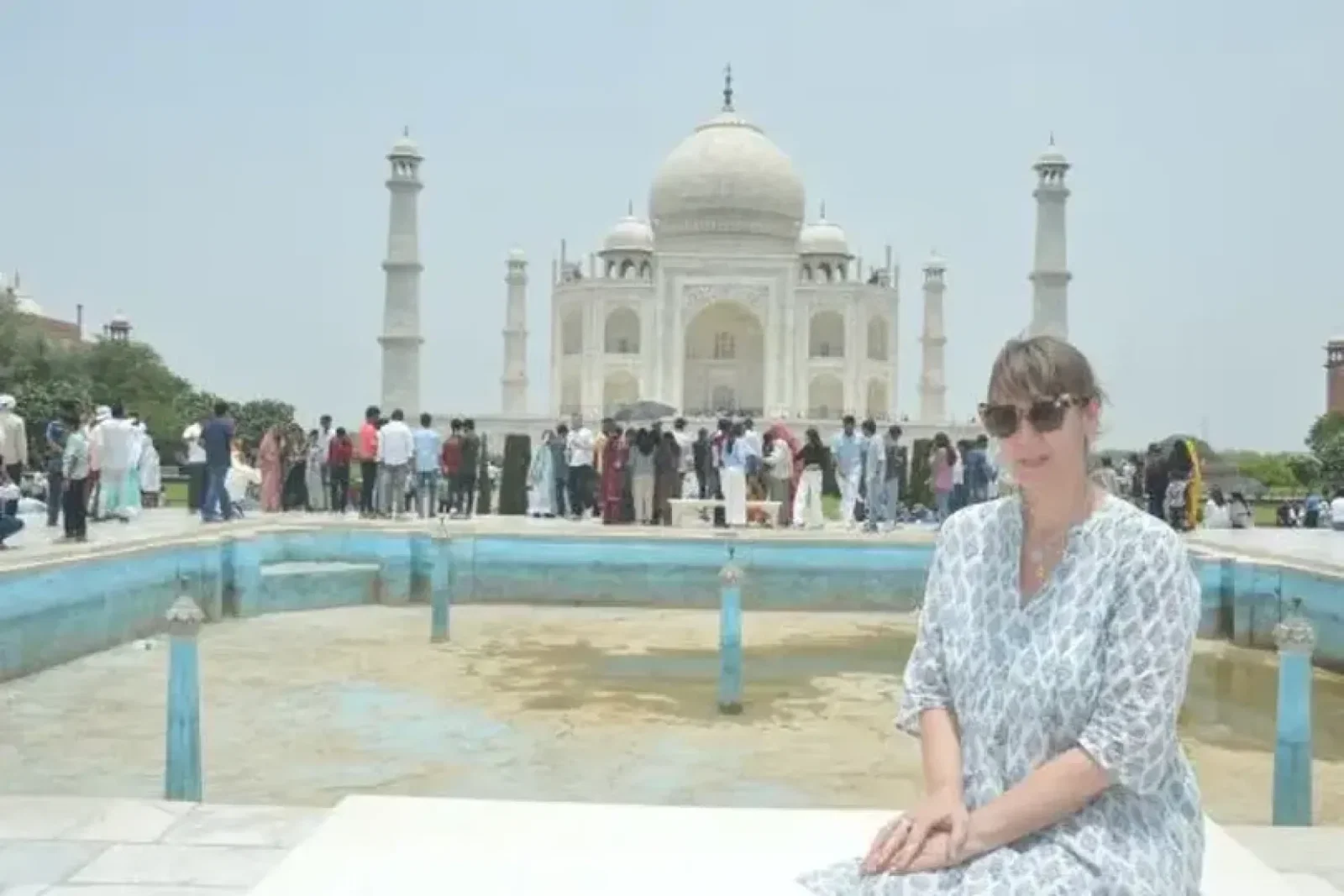
Then we explore the 16th century Humayun’s Tomb, built in memory of the Mughal emperor Mirza Nasir al-Din Muhammad by his wife. Its distinctive design, symmetry and ornamental detailing served as the inspiration for the Taj Mahal by a later Mughal emperor, Shah Jahan, for his dearly departed wife Mumtaz Mahal.
At this point it’s worth highlighting that Agra, where the Taj Mahal is located, is actually a three-hour drive each way from Delhi, so clients should be made aware that while stimulating, this is a slightly tiring day trip.
Back in the heart of Delhi, an exhilarating rickshaw ride follows for me, through the maze of narrow streets and alleyways that comprises Chandni Chowk, one of Old Delhi’s oldest, busiest and most characterful markets.
Our cyclo-driver weaves hair-raisingly through throngs of pedestrians, as we pass areas dedicated to different products, from silver and gold jewellery to embroidered fabrics, spices, shoes, stationery, and more. I pick up a sizeable pouch of saffron for less than £10 and a bag of tikka seasoning from Mehar Chand and Sons, a fifth generation tea and spice wholesaler on Khari Baoli street.
Afterwards, the car returns us to New Delhi, the part of the city which evolved during British colonial rule (from 1858 to 1947). We drive past the Viceroy’s House, now known by the Indian name, Rashtrapati Bhavan, or Presidential Palace, the official residence of the President of India.
Designed by Kensington-born Sir Edwin Lutyens – credited with creating ‘New’ Delhi in the colonial era – his architecture is further in evidence nearby, with various ministerial and government buildings lining the wide Kingsway boulevard (today called the Rajpath) which leads up to his majestic India Gate. This striking monument, which bears a resemblance to Paris’ Arc de Triomphe, was built as a war memorial dedicated to Indian soldiers who died in WWI.
Despite only scratching the surface of the city, the day is a whirlwind of chaos, and I feel relieved to return to the calming confines of the Leela Palace.
Located in the elegant environs of the Diplomatic Enclave, and ringed by embassies, parks and gardens, it’s a serene haven from all the tumult. Its 254 rooms and suites are set over 11 floors, tastefully decorated in tones of sand and cream.
Beds are vast, with exceptionally firm mattresses and there’s a menu offering a staggering choice of twelve different pillows, including non-allergenic and spelt-filled.
Clients taking their first tentative steps into home-grown Indian cuisine should book a table at high-end Jamavar, one of the Leela’s three restaurants, otherwise there’s exquisite modern Japanese cuisine at Megu – an outpost of the one in New York City – and a vast Indian and Western breakfast spread available at Qube.
“Clients will appreciate the fact that we have the largest-sized hotel rooms in the city,” the hotel’s general manager Preeti Makhija tells me. “As well as our proximity to many of the local landmarks being another benefit.”
As for me, I find real peace and quiet up on the hotel’s rooftop, with its long infinity pool which offers 360-degree views across the non-stop city below.
How to book it:
Virgin Atlantic recently celebrated the 25th anniversary of its London to Delhi route, which flies twice daily with fares from £2,412 return in Upper Class. Guests can enjoy Indian-inspired meal options alongside a wide selection of special dietary meals, while the inflight entertainment features a dedicated collection of Bollywood blockbusters and regional Indian titles. Rooms at the Leela Palace start from £154 per night in low season.