





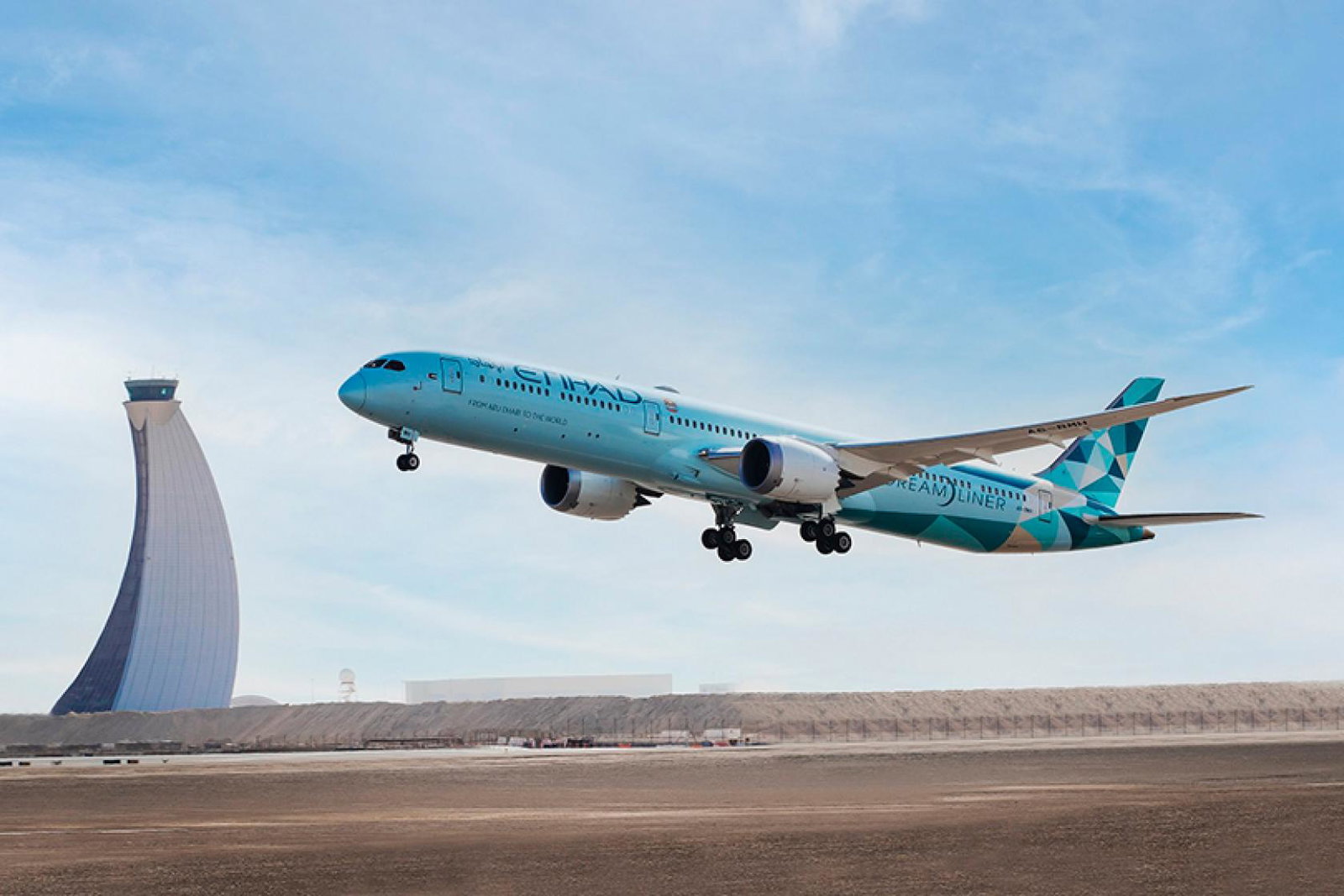
The flight from Abu Dhabi to Rome was its first ecoFlight of 2021 and is part of a series of trials under the Etihad Greenliner Programme.
The airline said the flight removed 1,731 pieces of plastic from service and reduced CO2 emissions by more than 1,925kg.
The Etihad Greenliner will operate as a carbon neutral aircraft for the whole of 2021 (covering approximately 80,000 tonnes of CO2), in what the airline says is the first full carbon offset programme in the region.
Etihad has worked with Boeing on creating the specially-themed Boeing 787 Dreamliner to test products, procedures and initiatives designed to reduce aircraft carbon emissions.
It said its trials and movement so far in the sustainability field were “uniting the technologists and visionaries together in a call to arms”, with the airline “encouraging and inviting partners from across the aviation sector to join and test sustainability initiatives on scheduled 787 operations”.
Any results are then processed and validated with Etihad and its partners, including Boeing and GE, and the most sustainable initiatives used as a base for improving the performance of the global 787 operating community.
While it is the first ecoFlight of this year, Etihad has flown three previous testing flights on the Greenliner.
On board, the trial focused on three key pillars: sustainable products; incorporating initiatives identified on past ecoFlights to reduce single-use plastics; and an overall weight reduction study.
“Etihad made a significant and tangible commitment to sustainability and the future of aviation over a year ago, first when we launched the Greenliner programme in partnership with Boeing, GE and other aviation leaders, then with our commitment to achieving net zero emissions by 2050 and halving our net emission levels by 2035,” said Tony Douglas, group chief executive officer, Etihad Aviation Group.
“Since then, and throughout the pandemic we have remained on track, with a number of ecoFlights during 2020, as well as partnering with Boeing, NASA and Safran on the 2020 ecoDemonstrator programme,” he added.
“Now in 2021 we are stepping up our efforts so eco testing won’t be confined to quarterly dedicated ecoFlights, but instead an ‘always on’, ever present part of operations to test, refine and implement sustainability initiatives. This kind of incremental, real world testing is the foundation of the Greenliner programme, which will allow us to continue R&D efforts into decarbonisation opportunities.”
What happened onboard?
- The Rome ecoFlight saw the removal and replacement of 1,731 single-use plastic items from onboard service, with a weight reduction of 108kg, saving 60kg CO2 emissions. This follows efforts on the first ecoFlight to Brisbane in 2019, where 43 single-use plastic items were removed from onboard operations, resulting in an annual saving of 17 tonnes of waste from landfill. In 2020, the airline operated an ecoFlight to Brussels, removing 2,639 single-use plastic items from the flight, equal to approximately 8.8kg in weight reduction. Etihad’s goal is to remove 80% of single-use plastics.
- The airline tackled international waste regulations with a recycling initiative to better manage cabin waste. Strict waste regulations force international airlines to incinerate all contaminated materials, and efforts were made to identify suppliers offering products that will not release harmful emissions in incineration, such as EcoWare bagasse pots, which are compostable and made from plants. The flight produced and diverted 8.1kg of recyclable material from landfill.
- Al Ain Water’s sustainable plant-based water bottles were used onboard. It also featured Abu Dhabi-based start-up The Concept’s sustainable inflight meal trays made from used water bottles, and BambuuBrush, for their sustainable up-cycled Bamboo Toothbrush.
- Operational initiatives trials were continued to evaluate and confirm learnings from past ecoFlights for flight path optimisation, including optimised climb and continuous descent. A previous ecoFlight to Dublin showed when compared to a standard Boeing 787 flight on that route, the ecoFlight reduced journey time by 40 minutes resulting in a reduction in CO2 emissions of three tonnes.
- Operational efficiencies on the ground meant the ecoFlight avoided 1,386kg of CO2. The flight also leveraged Boeing’s Probabilistic Flight Planning tool to optimise routing and fuel efficiency by evaluating possible routes, taking uncertainty in the weather forecast into account to use less fuel, regardless of the actual winds. This technology has the potential to reduce Etihad’s fleet-wide annual CO2 emissions by approximately 2 million kgs.