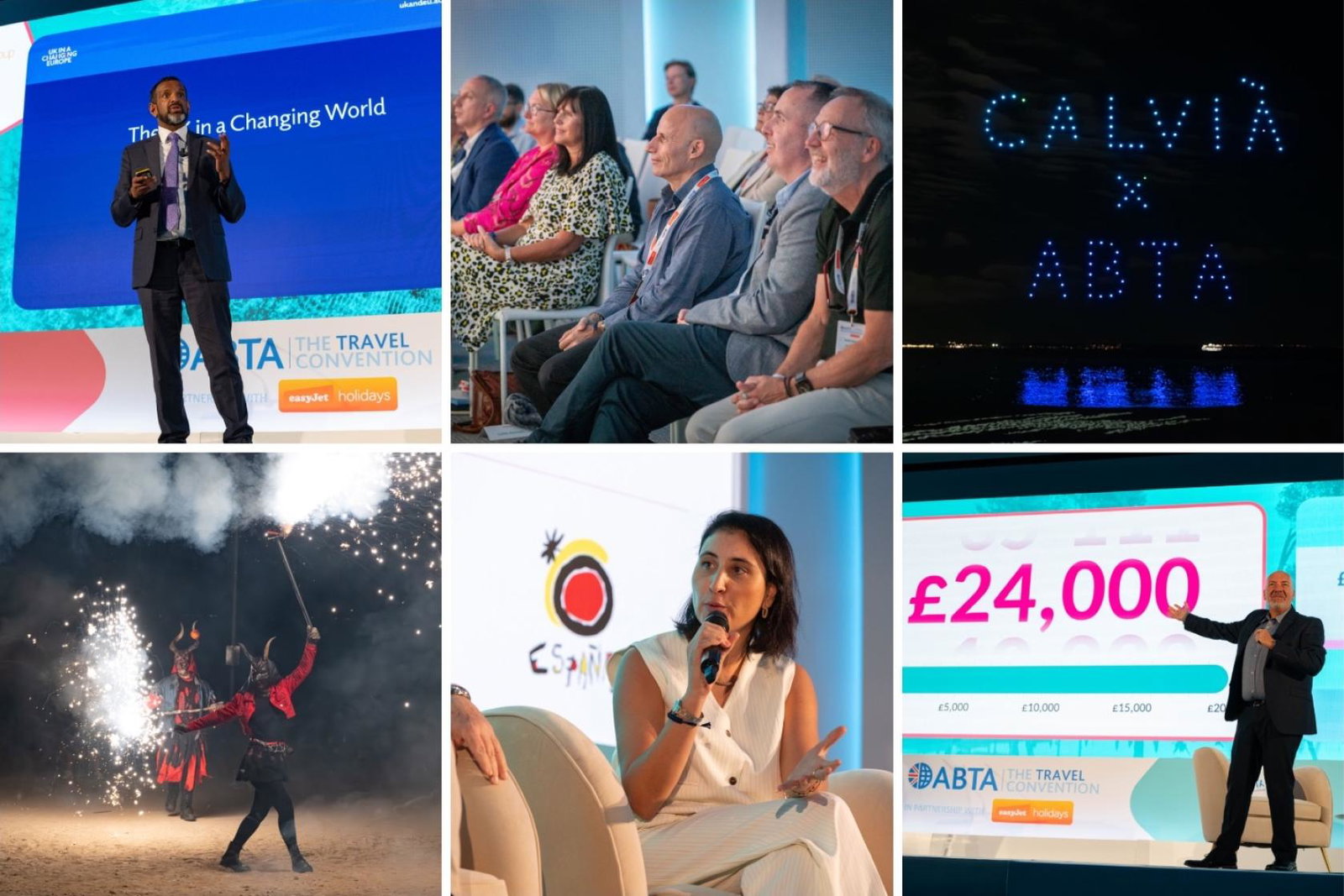
You could be forgiven for thinking that trying to set the agenda for the year ahead around "reasons to be cheerful" would be anything but a foolhardy endeavour.
Reasons for cheer, in case you hadn't noticed, have been in short supply of late, with national and international economies in turmoil, and global geopolitics at its most fragile for a generation.
But Abta Convention speakers and delegates alike rose to the challenge in Calvia this week, sharing thoughtful insight into their own challenges and those of their businesses, leveraging thousands of years of shared industry experience.

In fact, when you put it like that, it's perhaps less surprising that by Wednesday evening, after two days of conference sessions (and a few nights putting the world to rights), a path through the gloom began to emerge.
TTG was there to separate the light from the shade, the rough from the smooth. So here are 10 key things we took away with us from this year's convention – plus news of where delegates will be heading next year.
‘Travel is now a staple in people’s lives – and government recognises this’
Fittingly, it was Abta chief executive Mark Tanzer who set the scene for the convention around a theme of "reasons to be cheerful".
Addressing delegates via a Q&A with moderator Jonathan Samuels, Tanzer covered many of the challenges facing the industry – from climate change, overtourism and cyber-attacks to Donald Trump's second presidency and the likelihood of another global pandemic.
"We're living in a time of huge disruption," he told delegates. "We've got huge political change, particularly with President Trump in his second term.
"We're in a different world. I think many have said that there are decades where nothing happens and weeks where decades happen. It feels like we're in a very different place, so we have to work within that environment. The economy is a very important backdrop for everything we do."
However, Tanzer promptly transitioned to some of his reasons for cheer. "Underlying demand is still very strong – travel is now a staple in people's lives," he told delegates.
Tanzer praised the government's attitude towards outbound. "I think this government gets travel in a way that some of the previous governments haven't," he said.
He also welcomed efforts to reset the UK's relationship with the EU. "We've detected, if not exactly a thawing of that relationship, a more pragmatic approach," he noted.
Times of change, Tanzer added, were opportunities for innovation and renewal. "We've had some of the giant oaks... sadly disappear, [but] others have come up and filled their place. This all comes out of disrupted times."
‘Don’t expect everything to suddenly get better when Donald Trump’s presidency ends’
Professor Anand Menon, professor of European politics and foreign affairs at King’s College London, picked up the baton from Tanzer to put some more context behind the UK's relationship with the EU, and the effect of US politics on travel and global trade.
"The problem with US tariffs, of course, is that we have no earthly clue what's going on," he said. "If you think about Trump's trade policy, we don't know what his intentions are. That uncertainty is a nightmare for business. And it's kind of built in to the Trump administration. We don't know from one day to the next what will happen."
Menon said the UK, with its "relatively small, relatively open economy", was particularly susceptible to any disruption to international trade.
He added another issue was protectionism in general – not just the US, but the EU too. "US and EU businesses are lavishing their own business with eye-watering amounts of money to support them that we couldn't even dream of matching," he continued.
"It makes it harder for us to work with their markets. The world is becoming increasingly protectionist. It is becoming less interested in Europe.
"I think the important point is this – don't cross your fingers and say to yourself, 'well, when Trump has gone, everything will return to normal'."
‘It's inevitable some mature destinations are going to hit their limits’
Unsurprisingly, sustainability was a prominent theme of this year's convention as the many themes that spin off from it gradually transition from worthy signals of intent to business-critical norms consumers simply won't tolerate firms skating over.
It was fitting then that a senior leader from the world's most visited destinations, Spain, set out his country's stall; Manuel Butler, director of the Spanish Tourist Office in London, walked delegates through Spain's evolving tourism model.
Butler called for collaboration in pursuit of "a new business model for responsible tourism". "We have to invent it together," he said, comparing the status quo to fast fashion. "We are talking about fast tourism," said Butler. "We need social sustainability in tourism worldwide."
Spain's ambitions include expanding length of stay, spreading stays more evenly throughout the year and into shoulder seasons, identifying new destinations and getting more tourists out into Spain's regions, and – perhaps critically – putting control back in the hands of local people to determine not just the tourism they want, but also how much of it they can tolerate.
Butler was joined on the panel by Tui's head of sustainability Ian Corbett, who had a stark warning for delegates. "Some more mature destinations are going to reach their limits – [they] might need some rebalancing, some reinvention," he said.
By contrast, he reminded delegates there was no shortage of destinations seeking to grow, highlighting Tui's recent agreement to open five beach-focused hotels in Oman. Corbett said Tui's transition to a marketplace model would also help "actively shape and diversify demand", and drive an uptick in personalisation..
He said the power of AI would transform how people search for and book their holidays. "They'll be able to find all this fabulous stuff much more easily, really personalised to what they're looking for," he predicted, although he said there would still be room for "the help of a more traditional travel agent".
The panel was completed by Intrepid Travel managing director EMEA Zina Bencheikh, who said Intrepid's stance that tourism – done better or more positively – was undoubtedly a benefit to destinations and local people rather than a burden.
"We're for better tourism," she said. "It benefits communities and destinations in incredible ways. But [we need] real willingness to support operators like us bringing travellers who will spend more time and more money, and visit regions that are lesser visited."
This, she said, would tip the balance in favour of value rather than volume, adding overtourism – echoing Butler – is "mostly a problem of how tourism is distributed more than a problem of having too much tourism".
Is climate – or cost – driving the trend towards shoulder season travel?
Efforts to either address, or mitigate, climate change was a theme that ran throughout much of the conference, although the bosses of the UK's two largest travel firms put an intriguing conundrum to delegates.
Neil Swanson, managing director of Tui UK and Ireland, and Steve Heapy, chief executive of Jet2.com and Jet2holidays, suggested cost – and consumers' pursuit of value – was perhaps a bigger driver of a recent trend towards shoulder season travel, rather than rising summer temperatures in Europe's holiday hotspots.
Both leaders reaffirmed their believe climate change was happening. "What we're not seeing is people changing massively at the moment," said Swanson. "We're seeing families move into half-terms around that summer period. But whether there's a financial element rather than a climate element in that [I don't know]."
Heapy added: "There has been some shift into the shoulder periods. But whether that's influenced by climate or cost – the shoulder seasons are cheaper – I don't know and I don't think there's enough research being done on that. I'm not sure there's this massive shift to cooler destinations.
"People want to go away to hot countries. Our aircraft, in the peak season when at it's hottest, we're full."
Demand for packages and service of travel pros steady amid geopolitical shocks
Abta's annual Holiday Habits research put some of what Tui and Jet2 are seeing into some context. Its findings reveal nearly two-thirds (61%) of people who travelled abroad in the past 12 months booked a package – level with 2023 (61%) and down just 1% on last year's figure (62%).
This stat rises significantly among some of travel's most price-sensitive cohorts; 78% of families with children under the age of five booked a package over the past year, and 70% of families with children over the age of five.
Value also remains the top reason for booking a package, cited by 43% of the 2,001 respondents to Abta's survey. This is down slightly from 44% last year but is up from 2023's 42%, with value being the top reason for booking a package for the past three years.
Abta said its latest research also highlighted "a trend over the past few years towards more shoulder season travel". Respondents telling Abta they planned to travel in April (15%) and in June (18%) have gone up by two and three percentage points respectively over the past year, and in September by two percentage points to 17%.
These trends were more pronounced among those without children; 22% of adults over the age of 45 without children plan to travel in September (22%) and May (21%) to take advantage Abta said, of cooler, less busy travel periods.
Interestingly, fewer people booked their holidays with a travel professional over the past year, although a greater number of those that did (41%, +5ppts) said it gave them more confidence to travel. Abta said these figures had been "fairly consistent" over the past five years, while chief executive Mark Tanzer added agents "continue to be seen as trusted advisors".
In addition, Holiday Habits found demand for travel to the US and the Middle East was weathering geopolitical shocks, with US demand level and Middle East demand up three percentage points on 2023.
Meanwhile, two-thirds (65%) of respondents said recent heatwaves in the Med had not made them think twice about holidaying there, also a three percentage point increase on 2023.
B Corp status increasingly shaping people’s purchasing decisions
Discussions around sustainability and good business continued in a B Corp breakout session hosted by Intrepid Travel B Corp impact manager Rochelle Turner and Will Bicknell, founder of fintech platform Felloh.
Together, the duo put forward a compelling case for why they believe in balancing purpose and profit – and played down the notion becoming B Corp certified comes at a detriment to profitability. "B Corp is helping drive greater profits," said Turner. "We are all looking to grow."
Turner and Bicknell presented stats compiled by B Lab UK, which show how SME B Corps in the UK are seeing growth in annual turnover of nearly a quarter (24%) – eight times the 3% average across all SMEs.
Bicknell said B Corp was already shaping purchasing decisions. "It is a shorthand for people to understand a business has a purpose," he added. "I can trust that endorsement [rather than] just relying on some sort of marketing message."
‘Think about your colleagues before you think about your customers’
One of the most thought-provoking sessions was led by easyJet holidays' chief operating officer Matt Callaghan. For perhaps the only time during the entire convention, you could have heard a pin drop while he addressed delegates on how the employee experience shapes the customer experience.
His message? Design the employee experience before designing the customer experience. "Every touchpoint in our customers' journey is powered by people," he said. "And when those people don't have what they need, the customer feels it immediately."
Callaghan set out in stark terms just how much a failure to get the colleague experience right costs – a $9 trillion hit every year in terms of global GDP. Just one in 10 UK employees, he said, are engaged at work, meaning nine out of 10 are showing up without the energy, tools or motivation to give their best, including to customers.
"Imagine that playing out across your stores, your call centres, your airports operations, your DMCs or destination partners and teams," he continued. "The customer impact is direct. The operational truth is that if we make it hard for colleagues, we make it hard for customers."
Strengthening the colleague experience, Callaghan said, was a matter of ensuring businesses have sufficiently strong culture, while ensuring colleagues have everything they need to do their jobs. "If either one of those is missing, the experience collapses," Callaghan warned.
"Colleagues first, customer always."
‘Customers believe in us – they’re coming back time and time again’
Sticking with the 'reasons to be cheerful' theme, Abta invited four voices from the agency sector to share their outlook – and what they gleaned from the convention – towards the end of the second day's programme.
Dawson & Sanderson commercial director Judith Alderson picked up on Callaghan's tips to unlock "the joy of travel". "One thing I took away was the statistic that 80% of people feel travel and holidays are good for mental health, so maybe we should be prescribing them," she said.
Alderson added agencies had to ensure their teams "stay ahead of the game" and not let the rise of AI dilute agents' instincts, highlighting how an AI-led purchasing or booking experience will never being able to replicate "the human emotion behind a holiday purchase".
"It won't replace human beings, professionals," she said. "That's my opinion. I may be wrong, but I think we'll be around for many years to come."
Lisa McAuley, World Travel Holdings UK's new managing director, said she was finding solace in the enduring demand for travel. "It doesn't matter what report I read – the demand is there," she said.
Fresh into her new role with the cruise retailer, McAuley added she was buoyed by the sector's unending ability to innovate. "The inventory is also there, and the supply. I hear regularly cruise lines are excellent at innovation and giving people a reason to travel and cruise.
"These things sum up why there's cause for optimism – it doesn't matter whether you're an agent, operator, asset owner, cruise line or hotel – if the demand is there, we'll be OK."
Barrhead Travel managing director Nicki Tempest-Mitchell said she was finding reasons for cheer despite ongoing political and economic turmoil. She repeated an adage that drew admiration earlier in the convention – that when times are good, people want to holiday; and when times are bad, they need to holiday.
She highlighted the evolution of the youth travel market as a cause for optimism. "They no longer want to cut corners," she said.
"Young people are returning to the high street, [they] want to come and book their holiday on the high street. That's something I'm going to take back and look at, and what we're doing to attract them to our business."
Steve Witt, co-founder of Not Just Travel, said the shift to demand for quality over quantity was driving agencies to be better and better. "I think across the industry, we're all upping our game all the time," he said.
"AI and online competition is driving us to be better and better at what we do. And customers are demonstrating their belief in us by coming back to book time and time again."
Social commerce – the next big transformation for travel? (and opportunity for agents)
Even if Alderson and Witt's predictions that AI won't come for agents' jobs, the way in which travel is sold is nevertheless going to change and evolve over the coming years as it always has.
Enter "social commerce" – according to PwC Strategy& director Sam Farnfield, one in every £5 spent online is now being spent via social shopping and commerce, the act of selling products and services via social media.
Farnfield told delegates that by 2033, social commerce "will be 10 times the size of Amazon today" and presents "a really huge opportunity" in travel retail with few retailers having yet set up social shopfronts.
Citing Expedia research, Strategy& partner Eleanor Scott told delegates almost 80% of people rank social media as a key influence on their travel decisions. However, she said there was a disconnect between where people get their holiday influence and inspiration and where they book, positing why more travel firms aren't in both spaces.
Rick Jones, PwC's UK hospitality, sports and leisure sector leader, added that while the industry was still "in the foothills", social commerce and "the direct approach it allows" was likely to "transform the travel industry". "[It] is an untapped opportunity [and] will become increasingly prevalent. It could be a real area of change."
Don’t compete with AI on speed; double down on humanity instead
Writer, broadcaster and TED speaker Carl Honore was, somewhat ironically, given half an hour to talk delegates through "the power of slow".
He said in the age of AI, slowing down was more important than ever. "The things AI will do well, it will do them incredibly fast," he warned. "We cannot compete on speed with AI.
"What we need to do as humans how is double down on the stuff humans do best, the slow stuff – empathy, building trust, creativity, listening, reflection, love."
Honore said it was time to "double down on our humanity". "Human beings are slow," he added. "Remember what the economists tell us – the companies that shall inherit the earth are those who know how to balance fast and slow.
"That dynamic, that dance we're starting to experiment with more and more in the workplace these days between AI and humans is a perfect example of balancing fast and slow."
See you in Madeira – an Abta Convention first
Abta closed out the convention by revealing next year's host – Madeira. The conference will be held on the Portuguese island for the first time over 12-14 October 2025 at the Savoy Palace Hotel in Funchal.
Guests will also stay at the nearby Next by Savoy Signature hotel. Registration will open early next year.
Abta chief executive Mark Tanzer said: "While we’ve had the pleasure of holding the convention in other parts of Portugal – Lisbon in 2001 and the Azores in 2017 – this is the first time we’ll be heading to Madeira, for what promises to be a standout event."