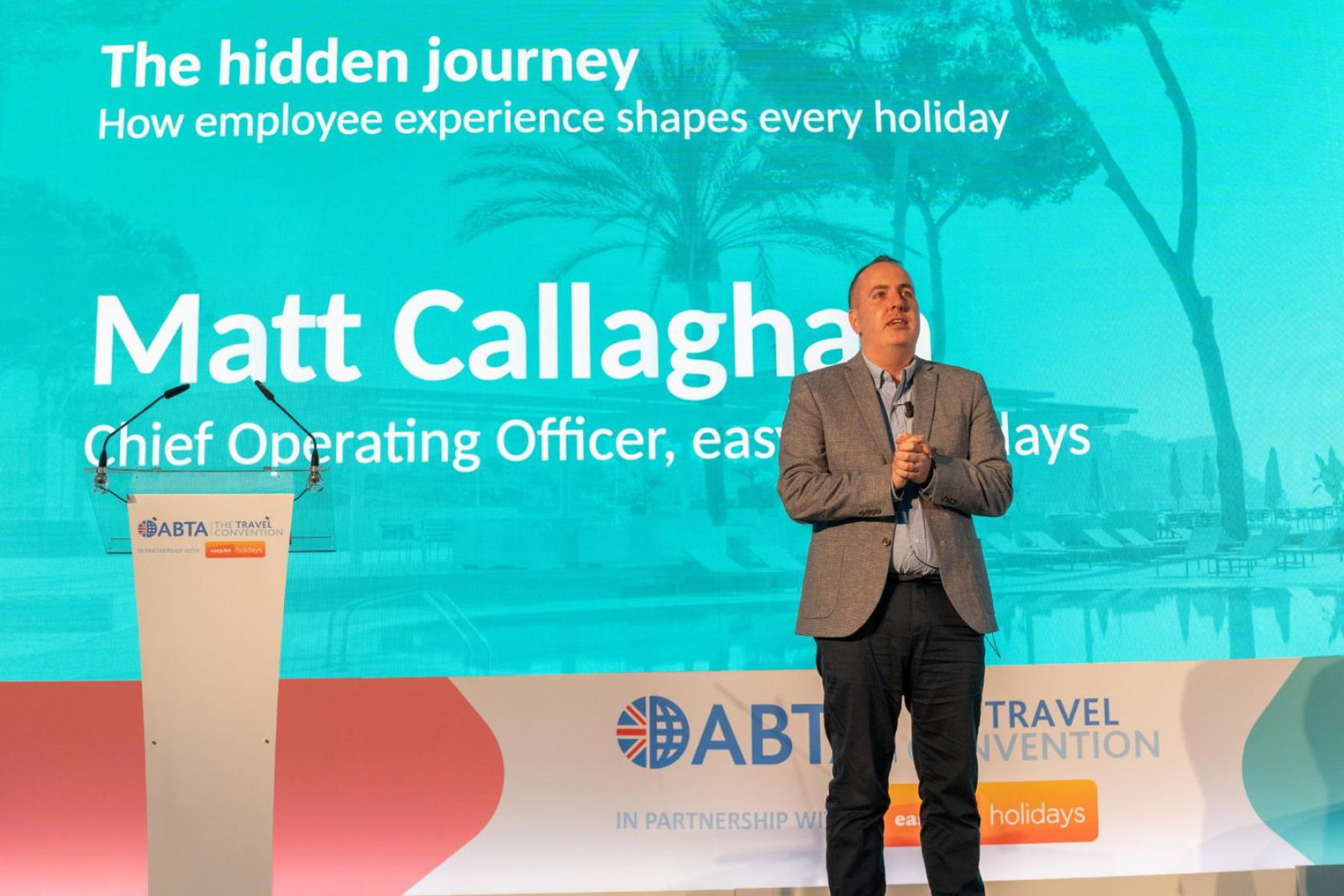
Matt Callaghan, easyJet holidays' chief operating officer, said customer experience was just "colleague experience seen from the outside". "Our industry is people heavy," he said. "High street agents, telephone sales agents, contact centre colleagues ground handlers, cabin crew, destination reps, hotel partners.
"Every touchpoint in our customers' journey is powered by people. And when those people don't have what they need, the customer feels it immediately."

Citing Gallup research, Callaghan told delegates highly engaged teams are 21% more profitable and 17% more productive. Poorly engaged teams, by contrast, cost the global economy $8.8 trillion, he revealed, almost 9% of global GDP.
According to Callaghan, only one in 10 UK employees say they are engaged at work, meaning nine out of 10 are showing up without the energy, tools or motivation to give their best, including to customers.
"Imagine that playing out across your stores, your call centres, your airports operations, your DMCs or destination partners and teams," he said. "The customer impact is direct. The operational truth is that if we make it hard for colleagues, we make it hard for customers."
Callaghan said in travel, when the baton is frequently passed between colleagues, partners and systems, any cracks "show instantly". But the value of getting it right is "exponential".
AI and other "enabling technology", he said, will only make this more apparent as it takes on repetitive admin, freeing people up to focus on more important tasks and priorities "that matter".
"Think of a holiday as a relay race," Callaghan continued. "Every colleague, partner, system and process is a baton pass. Drop the baton, and the whole race can feel lost. Why does this happen? it's not usually because colleagues don't care. It's because we've designed the customer journey without first thinking about and designing the colleague journey."
Strengthening colleague experience, Callaghan said, was a matter of ensuring businesses have sufficiently strong culture, while "ease" is about ensuring colleagues have everything they need to do their jobs. "If either one of those is missing, the experience collapses," Callaghan warned.
Culture, he said, is built on trust – giving employees autonomy to act and make key decisions – ensuring they feel valued and know what is expected of them, while ease is built on "clarity and tools".
Callaghan said the equation had to balance.
"If either side is zero, the whole thing collapses," he stressed. "A colleague might feel trusted, but if the systems are clunky, they simply can't deliver for customers. Or they might have brilliant tools, but if they don't feel recognised for their contribution , then they will disengage.
"When you get all four right, trust, recognition, clarity and tools, something powerful happens," he continued. "The colleague journey and the customer journey become one and the same. When colleagues have the will and the way, customers feel the difference immediately.
He cited as examples call centre colleagues leveraging AI rather than using six different systems, freeing them up to be more empathetic; trusting reps to act on the ground; and ensuring information flows seamlessly between partners ensuring a hotelier knows a particular customer's needs.